
The New Kadampa Tradition ~ International Kadampa Buddhist Union (NKT-IKBU) has been in operation in the modern world for well over 40 years now, and has helped umpteen people. Is it good? Yes. Is it perfect? No.
In the early years, especially, there were occasions of unfairness, heavy-handedness, bullying, and gaslighting, all of which have been pointed out by former members of the NKT who have named themselves the “New Kadampa Tradition Survivors”. Managers of the NKT have usually (though not always, I’m afraid) apologized to them, as they should; and over the years many rules and checks have been introduced and are now in place to try to avoid such harms. However, individual centers are run by humans who inevitably are going to make mistakes.
 Things are very different now to how they were back in the day, and the organization has in fact been very kind, gentle, and responsive for many years now. However, before I go on, I will say that I myself have been at the receiving end of shoddy treatment from managers in the past. I got through it at the time because I knew full well that it was not the fault of the tradition as a whole but of the delusions of those managers, not to mention my own karma. Also, that it was small fry compared to the huge amount of benefit I and others get every day from Kadampa Buddhism (see the articles on this site, for example). It is because I myself, and people I know, have been at the receiving end of unskillful behavior at some time or another over the past 40 years that I want to put up this article. I have not always agreed with how things are managed or handled, but I also know that none of the things I’ve witnessed or heard about has ever made this tradition into a cult or anything frankly resembling a cult. Nor does it deserve to be destroyed, as the most vocal survivors have said they want, and as they try to work towards.
People are invited to talk to their local managers or the Education Council Reps in the NKT office directly with any questions or concerns, and they have a strict policy of looking into them. When I see something is off, I have been happy to point it out, and to be fair the managers have listened and responded. I agree with this verdict from a friend of mine, I think he puts it well:
“Have mistakes been made within the NKT in the past? Definitely. Will they be made in the future? Definitely. As deeply regrettable as any mistake is – especially if anyone is hurt in any way in the process – I don’t know of any organisation (spiritual or otherwise) that hasn’t or won’t make mistakes over its lifetime. However, my own decades’ long experience within the NKT is that of a genuine humility and openness amongst practitioners and managers to learn and grow from these incidents. Instead of sweeping them under the carpet, I have seen issues tackled head on, and a tradition continually learning and developing as a result of this, to become a more compassionate and inclusive organisation that is continually evolving to embody the Mahayana teachings and lineage it exists to promote. That, at least for me, is the very definition of a healthy tradition.”
I think the NKT owes some gratitude to the “NKT Survivors” for pointing out legitimate causes for concern in the past. It means that the organization (which is not deliberately trying to do harm) has tried harder not to repeat the mistakes; and a lot of the survivors’ criticisms have resulted in improvements in the Centers, managers, and students, as well as more safeguards, accountability, and transparency. The survivors are therefore responsible for helping the NKT to improve.
Quite aside from the criticisms that have been heavily influenced by some Dalai Lama supporters (see below), the vast majority of the survivors’ criticisms are about events that occurred years ago. It doesn’t excuse those behaviors, of course, but it does show that the organization has improved. This can be seen in the absence of any new criticisms the NKT Survivors are making (apart from a few rather strange comments about Venerable Geshe Kelsang’s passing). New material tends to be memes of regular Kadampas wandering around, chatting, standing in front of shrines, or teaching, etc, with the addition of quotes.
 But some survivors are extremely over the top in their criticism, very unfair, harsh, and inaccurate. As explained here, Is the New Kadampa Tradition a cult?, the NKT survivors have been strongly influenced by supporters of the Dalai Lama who claimed we were a “cult” back in the nineties for demonstrating against his ban of our spiritual practice (see below). These Dalai Lama supporters and the NKT survivors have accused the New Kadampa Tradition of outlandish things such as spirit worship, book burning, being funded by the Chinese government, being a cult, being fake Buddhism, brainwashing, making people homeless, financial impropriety, having fake monks and nuns, destroying families, and even murder. They also claim Geshe Kelsang Gyatso disappeared or died years ago, and that he was never a Geshe. If someone interested in an NKT class searches online, they might land on sites run by “survivors” promoting these accusations. Taking these claims as gospel can deter people from exploring this tradition. While many people do check online sources, especially these days, repeated misinformation still causes harm.
Talking of sources, this might be a helpful article: Reviews and testimonials of the New Kadampa Tradition.
Reviews and testimonials of the New Kadampa Tradition (NKT) Kadampa Buddhism
Purpose of this article
Here in this article is information about the New Kadampa Tradition that directly or indirectly counters the survivors’ criticisms and accusations. As Kadampa Buddhists are not permitted to say anything good at all about this tradition on the survivors’ sites themselves, my hope is that people will see this article and know that the New Kadampa Tradition is nowhere near as bad as the survivors say it is.
Some people think that we shouldn’t dignify these accusations with a response, and just keep putting our best foot forward. Although I have sympathy for where that’s coming from, I have another opinion: I think people deserve to know the background and context for the criticisms and hear our responses. There is nothing to hide and indeed the NKT have been very open and transparent over the past 20 years in sharing how things are run and dealt with. (If I could get the comments section on this page to work, I would invite your comments or questions, but for the meantime please put them on one of the posts on this article and I’ll see it there.) And, full disclosure, although this information has been co-written by me and several other Kadampas who have been around for decades, this is not an official NKT article and I have not been asked to put it up by anyone else.
I don’t expect you to read the whole thing in one sitting, lol, but I have tried to include as much helpful information as possible in one place to consult when questions, concerns, or doubts come up. These broadly cover five areas:
- The New Kadampa Tradition’s relationship to other Buddhist groups, including the Dalai Lama’s followers
- What the New Kadampa Tradition is and how it is managed
- How Venerable Geshe Kelsang Gyatso is viewed by his students
- The books and qualifications of Venerable Geshe Kelsang Gyatso
- Answering miscellaneous claims
The Dharma Protector Dorje Shugden and the 14th Dalai Lama
In the 1990s the Dalai Lama banned the Buddhist practice of relying upon the Dharma Protector Dorje Shugden, who had been considered for over four centuries as a Wisdom Buddha who helps arrange favorable outer and inner conditions for an individual’s practice of Buddha’s teachings. This practice was taught extensively by Je Phabongkhapa and Vajradhara Trijang Rinpoche, the greatest Gelug Lamas of the 20th century, the latter being the Dalai Lama’s own root Guru. It was a practice which the majority of Tibetan Buddhists throughout most of the 20th century engaged in, including some of the greatest Lamas to come to the West. To name but a few, Lama Yeshe and Lama Zopa, founders of the Foundation for the Preservation of the Mahayana Tradition (FPMT); Geshe Rabten and Gonsar Rinpoche, founders of Rabten Choeling Monastary in Switzerland; Geshe Kelsang Gyatso, founder of the New Kadampa Tradition (NKT).
The Dalai Lama himself engaged in this practice, but later changed his mind and started calling Dorje Shugden practitioners sectarian spirit worshippers who were causing the degeneration of Buddhism into spirit worship and undermining the cause of Free Tibet and his own long life. He formally banned the practice of Dorje Shugden in the Tibetan community through the sanctions of being expelled from one’s monastery (hundreds of monks were expelled), losing one’s job, being deprived of basic social services, being denied access to teachings, being viewed as a national traitor, and facing complete social ostracization.
 The Dalai Lama’s followers further expanded his denunciation of the practice on a global scale, embarking on international forced signature campaigns and trying to destroy the credibility of all those who spoke out against this ban. By declaring that Dorje Shugden is a worldly spirit or evil demon, the Dalai Lama was saying that his spiritual lineage Gurus Trijang Rinpoche and Je Phabongkhapa were spirit-worshippers and he called them “wrong, all wrong”. If they were wrong, then the entire Gelug lineage is wrong since virtually all Gelugpas alive today are derived, directly or indirectly, from these two lineage Lamas.
The most immediate effect of this ban was the untold human anguish of those suffering under it. If left unchecked, the Dalai Lama’s actions would have had the result of extinguishing from the world the practice of Je Tsongkhapa’s tradition. For these reasons, Dorje Shugden practitioners around the world felt compelled to speak out publicly against this injustice. They included NKT students.
The Dalai Lama and his follower’s consider Dorje Shugden to be by nature a worldly being; Dorje Shugden practitioners consider Dorje Shugden to be by nature an enlightened being. Those who follow the Dalai Lama’s view can, of course, believe what they want, and Dorje Shugden practitioners should be allowed to believe what they want and engage freely in Dorje Shugden practice; there need be no controversy.
There is a lot more information to be found on this website: Wisdom Buddha Dorje Shugden. And I wrote an article on Buddhism in Daily Life about why I personally joined in the demonstrations here: Dalai Lama, please give religious freedom.
Why New Kadampa Tradition students joined in protests against the Dalai Lama
In the late ’90s the Dalai Lama banned the practice of the Dharma Protector Dorje Shugden, and his followers began to enforce this ban within the Tibetan community causing disharmony and immense suffering. Since this practice is one of the key practices of the New Kadampa Tradition (NKT), and to support fellow Tibetan Dorje Shugden practitioners, NKT practitioners joined in protests against the Dalai Lama’s ban. They were not wrong in protesting against the Dalai Lama’s suppression of the right and freedom to engage in this traditional religious practice. For the reasons why Kadampa practitioners everywhere oppose the Dalai Lama’s ban of their Protector practice, please scroll down.
 However, it was the Western Shugden Society (WSS) that organized protests against the Dalai Lama’s ban, and not the NKT. The WSS was an ad hoc coalition of Dorje Shugden practitioners – including NKT practitioners – from many different countries, and included more Tibetans than Westerners. This can be seen in this recent documentary called “Inside Tibet”.
The Western Shugden Society (WSS) was created in the late-’90s to organize protests against the Dalai Lama’s ban of the Dharma Protector practice of Dorje Shugden and the subsequent repression of religious freedom in the Tibetan community. It has been claimed that this was a front for the New Kadampa Tradition (NKT) and the NKT is still often criticized for being the ones doing all the protesting against this ban. However, the truth is that there were also a large number of Tibetan Dorje Shugden practitioners involved. The WSS no longer exists now that the protests against the Dalai Lama’s ban of Dharma Protector Dorje Shugden practice were successful in achieving some religious freedom.
Some NKT detractors created websites and blogs to allege that it was the NKT that was organizing demonstrations against the Dalai Lama because there were many NKT practitioners visible at the demonstrations. However, people who attended the demonstrations did so as individual Dorje Shugden practitioners, not as representatives of the NKT. Most people who practice Gelug or Kadampa Buddhism rely upon Dorje Shugden as their enlightened Dharma Protector, so it is not surprising that there were a great number of Kadampas supporting the protests.
These protests were not political but aimed at religious freedom
Many individual members of the New Kadampa Tradition (NKT) joined the Western Shugden Society’s (WSS) campaign to prevent the Dalai Lama from banning the practice of Dorje Shugden and disrupting the spiritual lives of millions of people. But these protests were not political. They were requests for religious freedom. In an open letter to the Dalai Lama the International Shugden Community made their position clear. They requested the Dalai Lama to write to the Tibetan communities throughout the world informing them of the following four points:
That both individuals and communities should completely stop all discrimination against the practice of Shugden and its practitioners; that they should maintain harmonious relationships with Shugden practitioners; That they should never try to harm Shugden practitioners either directly or indirectly; That they should solve this present problem by practically applying the above three points.
They believed that if this happened it would solve all the problems and the demonstrations could stop. Two things should be noted: (1) the NKT is not the same as the WSS; and (2) the actions of the WSS were not political in nature. On the contrary, their aim was to free Buddhism from politics. The WSS no longer exists because it is felt that the problems have been resolved. As it says in the Moral Discipline Guide: the Internal Rules of the New Kadampa Tradition (known as the NKT Internal Rules),
the NKT must always remain free from any political affiliation.
New Kadampa Tradition students are Buddhists who do not worship a spirit
As with all Buddhist traditions, the objects of refuge for Kadampa Buddhists are Buddha, the Dharma he taught, and the Sangha (spiritual community) following those teachings. All teaching and meditation sessions at all NKT Centers begin with The Liberating Prayer, which is a praise to Buddha Shakyamuni. As Buddhists, NKT practitioners never go for refuge to an object other than the Three Jewels of Buddha, Dharma, and Sangha.
As part of their spiritual practice, NKT practitioners rely upon the Dharma Protector Dorje Shugden – who is seen as one with the Wisdom Buddha Manjushri (pictured) – to help them gain realizations of Buddha’s teachings of Sutra and Tantra. The Dalai Lama mistakenly pronounced that Dorje Shugden is an evil spirit or demon, and in this he rejected the view of his own teachers, in particular Vajradhara Trijang Rinpoche, who the Dalai Lama has called “his root Guru”. This is his opinion, but there are a great many Gelug and Sakya Lamas and practitioners who disagree with him.
The Dalai Lama’s pronouncements on this subject have led to most of the demonization and marginalization NKT students found in the world today, but they are not based on any truth or any practitioner’s experience.
The Dalai Lama is entitled to his own opinions
It is true to say that the Dalai Lama is entitled to his own opinions and freedom to practice. The problem is in using his status and position to impose his opinions on others, saying that everyone else, including his teachers, was “wrong”, and taking away others’ freedom to practice through banning the practice of Dorje Shugden and the resultant oppression within the Tibetan communities. Pronouncing his own Gurus and all Dorje Shugden practitioners, past and present, to be spirit or demon worshippers is shocking and has caused untold harm and destroyed harmony within Tibetan communities and amongst practitioners in the West.
For a detailed, academic history of Protector Dorje Shugden based on the legacy of rituals, historical works, and art, please see Dorje Shugden History.
The relationship between the New Kadampa Tradition and the 14th Dalai Lama Tenzin Gyatso
The New Kadampa Tradition (NKT) is not related to the 14th Dalai Lama, either spiritually or politically. Although the Founder of the NKT, Ven. Geshe Kelsang Gyatso, came from Tibet, the Dalai Lama was never his Teacher. The teachings that Geshe Kelsang presented, and which are followed by NKT practitioners, come from a lineage that includes both Indian Buddhist Teachers such as Atisha, and Tibetan Buddhist Teachers such as Je Tsongkhapa. The teachings, however, are universal and neither Indian nor Tibetan. Furthermore, Geshe Kelsang has never accepted the Dalai Lama’s, or anyone’s, political authority over spiritual matters.
 After the Dalai Lama used his political authority to enforce his ban of the ancient religious practice of the Protector Dorje Shugden, which is one of the NKT’s religious practices, NKT practitioners among others protested against this ban and the subsequent oppression of Tibetan practitioners of Dorje Shugden in India, Nepal and elsewhere. However, no NKT Teacher has ever asked their students to reject the Dalai Lama.
In denigrating the practice of Dorje Shugden, it is the Dalai Lama who has rejected the NKT. In a Newsweek article, other media, and in talks to Tibetans, he has said “no Shugden practitioner can be my friend”. He does not allow Dorje Shugden practitioners to attend his teachings.
Geshe Kelsang had often said that everyone has choice as to what they believe and practice. However, once someone has chosen a spiritual tradition, he advises them to rely upon this tradition, while continuing always to respect and appreciate other traditions, both Buddhist and non-Buddhist.
The New Kadampa Tradition is part of the Mahayana Buddhist tradition called “Gelugpa”
New Kadampa Tradition (NKT) practitioners are Gelugpas. Those who exclusively follow Je Tsongkhapa’s teachings are called “Gelugpas’. The NKT is a Gelugpa tradition because (1) all its teachings are from Je Tsongkhapa’s doctrine, (2) its lineage Gurus from Je Tsongkhapa onwards are exclusively Gelugpas, and (3) Ven. Geshe Kelsang’s spiritual education and root Guru (Trijang Rinpoche) are within the Gelugpa tradition. In 1998 Geshe Kelsang stated in an interview:
We are pure Gelugpas. The name Gelugpa doesn’t matter, but we believe we are following the pure tradition of Je Tsongkhapa. We are studying and practicing Lama Tsongkhapa’s teachings and taking as our example what the ancient Kadampa Lamas and Geshes did. All the books that I have written are commentaries to Lama Tsongkhapa’s teachings. We try our best to follow the example of the ancient Kadampa tradition and use the name Kadampa to remind people to practice purely.
The Gelug or ‘Virtuous Tradition’ (also known as the ‘Ganden’ tradition) was founded by Je Tsongkhapa (1357-1419 CE), considered to be an emanation of Wisdom Buddha Manjushri. As predicted by Buddha Shakyamuni himself in Root Tantra of Manjushri, Je Tsongkhapa appeared in Tibet, the ‘Land of the Snows’, to re-establish the purity of Buddha Shakyamuni’s doctrine by establishing the ‘Ganden’ (‘Joyful Land’) tradition.
 Geshe Kelsang first introduced the title “New Kadampa Tradition” to give the Centers under his spiritual direction a distinct identity within the wider Buddhist world. Although the Gelugpas were sometimes referred to as ‘new Kadampas’, the name “New Kadampa Tradition” had never been used previously in a formal sense. Nevertheless, by using this title, Geshe Kelsang is making it clear that practitioners of this tradition are principally following the teachings and example of Je Tsongkhapa. The word “New” is used not to imply that it is newly created, but that it is a fresh presentation of Buddhadharma in a form and manner that is appropriate to the needs and conditions of the modern world. Furthermore, by using the title “Kadampa”, Geshe Kelsang encourages his disciples to follow the perfect example of simplicity and purity of practice shown by Atisha and the Kadampa Geshes.
The NKT teaches Buddha’s doctrine as passed down through the great 14th century Tibetan master Je Tsongkhapa
All of Geshe Kelsang’s books, which are the core of the three Kadampa study programs, are based on Je Tsongkhapa’s commentaries to the teachings of Buddha Shakyamuni, Buddha Vajradhara, and other great Buddhist Masters. For example:
| Je Tsongkhapa’s Books | Geshe Kelsang’s Books |
| Lamp Thoroughly Illuminating the Five Stages | Clear Light of Bliss |
| Great Exposition of the Stages of Secret Mantra | Tantric Grounds and Paths |
| Great Exposition of the Stages of the Path to Enlightenment (Lamrim Chenmo) | Joyful Path of Good Fortune |
| Sunrays of Training the Mind (notes compiled by Je Tsongkhapa’s students) | Universal Compassion |
| Je Tsongkhapa’s teachings on Commentary to Valid Cognition by Dharmakirti | How to Understand the Mind |
| Illuminating All Hidden Meanings (Be dön kun säl) | The New Guide to Dakini Land |
| Illuminating All Hidden Meanings (Be dön kun säl) and commentary to the Heruka sadhana called Wishfulfilling (Dö jo) | Essence of Vajrayana |
| Clear Illumination of the Intention: An Extensive Explanation of the Great Treatise ‘Guide to the Middle Way’ by Chandrakirti | Ocean of Nectar |
Geshe Kelsang’s remaining books come from Je Tsongkhapa’s Lamrim (stages of the path) and Lojong (training the mind) teachings, from the Ganden oral lineage instructions passed on to him by his root Guru, from the Kadam Emanation Scripture, and from Shantideva’s Guide to the Bodhisattva’s Way of Life.
While the presentation of the teachings is especially suited to people in this modern world, the meaning of the teachings has not been compromised: the teachings are the same as those given by Je Tsongkhapa himself.
The NKT lineage Gurus from Je Tsongkhapa onwards are exclusively Gelugpas
The NKT has an unbroken lineage of spiritual teachers from Buddha Shakyamuni to the present day. There is an unbroken lineage from Buddha to Je Tsongkhapa, and an unbroken Gelugpa lineage from Je Tsongkhapa to Geshe Kelsang Gyatso (see Great Treasury of Merit p. 99-100. The lineage shows that the Buddhadharma practised in the NKT is, firstly, actual Buddhism in that it is the teachings of Buddha Shakyamuni; and, secondly, actual Gelugpa in that it is the teachings of Je Tsongkhapa.
Geshe Kelsang’s spiritual education and root Guru (Trijang Rinpoche) are within the Gelugpa tradition
Geshe Kelsang received his spiritual education in the Gelugpa tradition, at Jampa Ling and Sera Je Monasteries, and principally from his root Guru, the great Gelugpa Master Kyabje Trijang Dorjechang. In addition to having been trained in the Gelugpa tradition, Geshe Kelsang continued to follow the guidance and example of Trijang Rinpoche by devoting his whole life to promoting Je Tsongkhapa’s tradition, carefully basing every one of his writings and teachings on Je Tsongkhapa’s teachings, and especially by remaining uninfluenced by worldly concerns, thereby acting in accordance with the meaning of Buddha’s teachings.
The New Kadampa Tradition is authentic Buddhism tracing back to Buddha Shakyamuni
 The New Kadampa Tradition (NKT) is not fake Buddhism nor a Western degeneration of proper Buddhism, as survivors have alleged. Since the NKT follows the entirety of the Mahayana Buddhist teachings of the great Buddhist Masters Atisha (982-1054 CE) and Je Tsongkhapa (1357-1419 CE), which are traced back to Buddha Shakyamuni himself (500 BCE), it is neither false, nor unorthodox, nor a degeneration.
The occasional claim that the NKT have culturally appropriated the word ‘Kadampa’ as their own label is also mistaken and misleading. To quote this description from a non-NKT Gelugpa Lama, we agree with every word and are followers in this unbroken lineage:
About the Old Kadam Tradition: Atisha (982-1054), the Indian Buddhist scholar and saint, is well-known as the founder of the Kadam tradition in Tibet. Following the first dissemination of Buddhism in Tibet through Padmasambhava and the Nyingma school in the 700s, he was invited by the Tibetan King to revive its flourishing. As one of the last great masters of Vikramashila Monastery (which along with Nalanda Monastery was the greatest Buddhist university of ancient India), he brought with him the best of the highly developed Indian Mahayana Buddhist traditions. He firmly anchored the authentic, pure teachings of Buddhism in Tibet, making them widespread in all important aspects of sutra and tantra.
About the New Kadam Tradition: Some 300 years later, Je Tsongkhapa (1357-1419) rejuvenated and further built on the foundations of Atisha’s system of study, analytical thinking, and deep meditative practices. Including teachings from the Sakya and Kagyu schools, he emphasized systematic, gradual development, known as Lam Rim. His teachings came to be known as the New Kadam tradition, which has been flourishing through a long line of great lineage teachers up to the present day.
INFORM do not include the New Kadampa Tradition in the category New Religious Movement (NRM)
Some years ago, the two most vocal NKT survivors organized followers of the Dalai Lama and survivors in the UK to contact INFORM and ask them to investigate the New Kadampa Tradition as an NRM or cult. The claims were noted, but this didn’t go anywhere; and INFORM currently simply includes the NKT amongst the other Buddhist traditions, saying:
The NKT bases its teachings on Gyatso’s commentaries of Je Tsongkhapa (1357-1419), who revived the teachings of Atisha (982-1054) the founder of the Kadam order of Buddhism in Tibet (which later evolved into the Gelug tradition).
However, this campaign set the tone for this label and the “cult” label to be used liberally when criticizing the NKT. To this day, one of those vocal survivors regularly claims that the organization INFORM have labelled the New Kadampa Tradition (NKT) a New Religious Movement (NRM) and asks people to write to them to complain about us. (This person says they were made homeless by the NKT by being asked to leave their Center some decades ago.)
In summary, what is the New Kadampa Tradition (NKT)?
The NKT is a Mahayana Buddhist tradition, arising from the teachings of the historical Buddha, Buddha Shakyamuni. It has historical connections with the lineage of Buddhism as it passed through Tibet, rather than being a Tibetan Buddhist tradition. The reason for this is that Ven. Geshe Kelsang Gyatso wishes NKT practitioners always:
to present Dharma in a way appropriate to their own culture and society without the need to adopt Tibetan language and customs.
For example, NKT practitioners do not recite prayers or study in Tibetan, practice reliance on oracles, recognize Tulkus (reincarnated teachers), do Lama dancing, or use prayer wheels, prayer flags, and so forth, which all come from Tibetan culture. Nor do they engage in any political activity whatsoever, including Tibetan politics, such as the campaign to free Tibet.
There is precedent for this. When Buddhism moved from India to Tibet, Tibetan Buddhism was not a ‘splinter group’ from the main Indian traditions but a new development of Buddha Shakyamuni’s teachings in Tibet, and its practitioners were Tibetan (not Indian) Buddhists. In the same way, the NKT is a new development of Buddha Shakyamuni’s teachings in the modern world and NKT practitioners are Buddhists of all nationalities.
The NKT is therefore not a “new” movement in terms of doctrine, but an ancient Mahayana tradition whose presentation has been adapted to the modern world. Paradoxically, the NKT is described by some as “traditionalist” and “orthodox” in its presentation of Buddha’s teachings, yet at the same time called by others an NRM for compromising on tradition.
As mentioned above, the NKT follows the Gelug tradition that has been passed down from Je Tsongkhapa (1357-1419 AD) and whose teachings can be traced back through a line of lineage teachers to Buddha Shakyamuni himself. Therefore, Kadampa Buddhism started in India, spent a period in Tibet, and is now flourishing in many countries throughout the world.
While there are Tibetans who are (and have been) Kadampas and Gelugpas, Kadampa and Gelugpa Buddhism are not uniquely or naturally Tibetan. Although Je Tsongkhapa was born in Tibet, it is not necessary to be a Tibetan Buddhist in order to be a Gelugpa. Je Tsongkhapa presented the timeless wisdom of Buddha Shakyamuni, which is independent of culture and nationality. There is no contradiction between claiming a pure Tibetan lineage and separating completely from the contemporary Tibetan establishment and other Tibetan Buddhist groups, as some have suggested, claiming that it is an NRM deriving from Tibetan Buddhism, from which it has broken away.
Everyone who practices Je Tsongkhapa’s special explanation of Buddha’s teachings purely without mixing is a Gelugpa, and so the NKT is definitely a Gelugpa tradition. However, the NKT is quite separate and different from a Tibetan tradition. Its prayers and teachings are not in Tibetan, it has no relationship with the Dalai Lama, it has no political affiliations, and the presentation of its teachings has been adapted to fit with the modern world. It is Gelugpa in terms of view, practice, and action, rather than in terms of being a member of a Tibetan Gelugpa organization.
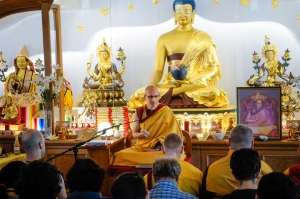 The presentation of Kadampa Buddhism by Ven Geshe Kelsang is a modern incarnation of this ancient spiritual tradition and its presentation is especially suitable for modern-day practitioners. Before he passed away, his root Guru Vajradhara Trijang Rinpoche advised Geshe Kelsang to teach in accordance with the needs of his students. Therefore, this presentation has been designed by Geshe Kelsang with the permission and encouragement of Trijang Rinpoche. Judging by the increasing number of Kadampa students throughout the world, it is working very well. The NKT is not part of Tibetan Buddhism as it has separated out from the Tibetan hierarchy to become an independent organization. This was done so as not to compromise Dharma by allowing it to become mixed with politics.
The New Kadampa Tradition and other Buddhist traditions
The New Kadampa Tradition respects other Buddhist traditions
Quite the opposite to what NKT survivors like to say, the New Kadampa Tradition (NKT) respects all other Buddhist traditions. It promotes a traditional path rather than an “exclusive” one. It has never said that it is the only pure or valid Buddhist tradition, or that it is better than any other. Ven. Geshe Kelsang Gyatso said in June 2008:
In the NKT we promote the view of respecting all other Buddhist traditions as well as other religions, and we rejoice in their virtuous and beneficial activities, but we do not emphasize studying all of them, in the same way that at a science college religious studies are not emphasized, or at a medical school architecture is not part of their curriculum. Nevertheless, we place emphasis in respecting all other religions, and if people wish they can also study them.
According to James Belither, former Secretary of the NKT, who worked very closely with Ven. Geshe Kelsang for decades:
Considering the NKT’s position regarding the Tibetan traditions in general, Geshe Kelsang has stated on innumerable occasions that he deeply appreciates all four Tibetan Buddhist traditions, praises Buddhist masters from all four schools in his books, and teaches that all four schools provide a complete and valid path to enlightenment. The over 4,000 pages of his collected writings contain not a single criticism of any other spiritual tradition, Buddhist or non-Buddhist.
Moreover, the NKT has never excluded those of different religious beliefs and backgrounds from its teachings and activities. On the contrary – the NKT means it when it says “Everybody welcome”. Local Center websites usually say something to the effect:
We do not discriminate based on race, gender, background, age, religion, politics, sexual orientation, or otherwise — everyone is always welcome at this Center and the other Centers around the world.
What do most Buddhist groups think about the New Kadampa Tradition?
The survivors like to claim that other Buddhist groups despise the New Kadampa Tradition, but this is far from true. The NKT gets along well with most other Buddhist groups, such as Theravadin Buddhists, the Triratna Buddhist Community (FWBO), and so on. However, NKT Centers and practitioners have run into problems with certain Tibetan Buddhist groups – those influenced by the views and politics of the Dalai Lama. For years after the Dalai Lama issued a ban on the practice of the Wisdom Buddha Dorje Shugden, and NKT practitioners protested against this, NKT students and Centers experienced numerous incidents of criticism and discrimination in the real world and on the Internet. They were accused of being evil spirit-worshippers and cultists, even murderers and Nazis. They were heckled, shouted and spat at on the street, denied entry into other Tibetan Buddhist organizations, warned against attending or returning to NKT Centers, threatened face-to-face and over the phone. They had branch classes cancelled, Centers vandalized, publicity torn down or defaced. They were barred entry to online Buddhist forums such as E-Sangha and Reddit.
Reddit r/Buddhism and the New Kadampa Tradition
Things are better now, but there is still some harassment online; and Reddit, for example, still won’t allow any Kadampa Buddhist to post or comment on the Reddit r/Buddhism page. See this article: Why does Reddit r/Buddhism falsely brand the New Kadampa Tradition a cult? Short answer is that the Reddit r/Buddhism moderators think we are sponsored by the Chinese Communist Party, based on absolutely nothing: “any content that is directly related to and in support of the NKT will be considered from here on out to be political propaganda for the Chinese Communist Party and swiftly removed.”
Why does Reddit r/Buddhism falsely brand the New Kadampa Tradition (NKT) as a cult?
Despite all of this, what has been experienced by NKT practitioners pales next to the persecution suffered by Dorje Shugden practitioners in India, some of which is documented here: Wisdom Buddha Dorje Shugden ~ Why is the Dalai Lama Suppressing Religious Freedom?
 Not all Tibetan Buddhist groups are opposed to the NKT, by any means. There are many Tibetan Buddhists relying upon Je Tsongkhapa’s and Trijang Rinpoche’s lineage teachings and Dharma Protector Dorje Shugden in India, Tibet, and the West who greatly appreciate the NKT and NKT practitioners. This is not least because Ven. Geshe Kelsang stood up for them and is considered both a great hero and a fully realized Buddhist master. Several monasteries were able to open in India due to the support of the Western Shugden Society, with hundreds of monks (many of whom had ben expelled from their previous monastery by the Dalai Lama), including Serpom Monastery and Segyu Gaden Phodrang Monastery.
There are also various Tibetan Buddhist groups who have their own problems with the Dalai Lama, such as those Kagyus who oppose his choice of the head of their tradition; and therefore they never jumped on the bandwagon of condemning the NKT for continuing to rely on Dorje Shugden and speak up for Dorje Shugden practitioners in defiance of the Dalai Lama’s ban.
New Kadampa Tradition students can go where they please
The survivors often try to scare people off with the untruth that New Kadampa Tradition (NKT) students are not allowed to attend teachings from other Buddhist teachers. But this is not true. Kadampas have freedom. They can, and do, go where they want.
It is true that NKT students, if they have chosen their spiritual path, are encouraged to emphasize their own practices and teachings, understanding them to present a complete path to enlightenment. However, this advice is given in the context of non-sectarianism, respecting other traditions and seeing them as also having a complete path to liberation or enlightenment. Those attending NKT classes are literally never told that they must listen only to NKT teachers. For example, one person wrote in early 2009:
I have practiced at both the FPMT and the NKT for over two years. Throughout that time I was in Foundation Program. My NKT Centre has known this and I’ve had frank discussions about it with all involved, including the Resident Teacher. It’s never been an issue. They have also known I took my refuge vows with the FPMT. My teacher even offered to start calling me by my refuge name (yes, you guessed it – it doesn’t have Kelsang in it). I’ve also told them that I have attended classes at the Tibetan Buddhist Society (another Gelug organisation), at Diamond Way (a Karma Kagyu school) and at The Institute of Tibetan Healing Practices (another Gelug-based group).
Buddhism and the New Kadampa Tradition are not sectarian or evangelical
Again, to scare people off, NKT survivors accuse the New Kadampa Tradition (NKT) of being sectarian and intolerant, but this is far from the truth because the NKT in fact actively and vocally respects all religions and people’s right to practice however they wish. This is in keeping with Buddha’s non-evangelical approach. There are many good reasons why different people want and need different spiritual traditions (or no tradition). As Ven Geshe Kelsang says:
Each tradition has its own uncommon good qualities, and it is important not to lose these.
The NKT-IKBU studies and practices its own tradition but sincerely respects other spiritual traditions – this point is included in the NKT Internal Rule 8§3. Sectarianism is discriminating against another tradition, religion, or school. It implies being bigoted or narrow-minded. Non-sectarian does not mean practicing all traditions, but having respect for all traditions and not criticizing them.
The NKT was marginalized by some into a “sect”, as opposed to a part of mainstream Buddhism, when the 14th Dalai Lama said publicly and with no valid reason that Dorje Shugden practice promotes sectarianism. Paradoxically, he was, at the time, unlawfully enforcing a ban on a nearly 400-year-old religious tradition.
From an interview with Geshe Kelsang Gyatso with Donald Lopez Jr in Tricycle Magazine, Spring 1998:
LOPEZ: Given your devotion to Dorje Shugden and your founding of the New Kadampa Tradition, do you feel that Je Tsongkhapa’s view, meditation, and practice is the most complete in all Tibetan Buddhism? Is it only through Je Tsongkhapa’s teachings that one can attain enlightenment? Or is it also possible through Nyingma or Kagyu?
GESHE KELSANG GYATSO: Of course! Of course we believe that every Nyingma and Kagyupa have their complete path. Not only Gelugpa. I believe that Nyingmapas have a complete path. Of course, Kagyupas are very special. We very much appreciate the example of Marpa and Milarepa [in the Kagyu lineage]. Milarepa showed the best example of Guru devotion. Of course the Kagyupas as well as the Nyingmapas and the Sakyupas, have a complete path to enlightenment. Many Nyingmapas and Kagyupas practice very sincerely and are not just studying intellectually. I think that some Gelugpa practitioners need to follow their practical example. But we don’t need to mix our traditions. Each tradition has its own uncommon good qualities, and it is important not to lose these. We should concentrate on our own tradition and maintain the good qualities of our tradition, but we should always keep good relations with each other and never argue or criticize each other. What I would like to request is that we should improve our traditions while maintaining good relations with each other.
 Ven. Geshe Kelsang has taught that the most effective method to gain spiritual realizations is to practice one tradition sincerely without mixing. Just as people have the right to mix traditions if they wish, and should not be criticized for doing this, others should also have the right to practice one tradition without being criticized. By emphasizing one tradition sincerely, the NKT is not saying that it is better than other traditions; just that this method works the best for those of this tradition.
As Mahayana Buddhists who understand that living beings need to be helped in different ways according to their differing karmic inclinations, the NKT never says that it is the best and that other traditions are inferior. Rather, the NKT respects and appreciates other traditions, and refrains from criticizing them. In this way, the NKT is non-sectarian. As it says in How to Understand the Mind: the Nature and Power of the Mind:
Every Teacher and every tradition has a slightly different approach and employs different methods. The practices taught by one Teacher will differ from those taught by another, and if we try to combine them we will become confused, develop doubts, and lose direction. If we try to create a synthesis of different traditions we will destroy the special power of each and be left only with a mishmash of our own making that will be a source of confusion and doubt. Having chosen our tradition and our daily practices we should rely upon them single-pointedly, never allowing dissatisfaction to arise. At the same time as cherishing our own tradition we should respect all other traditions and the right of each individual to follow the tradition of their choosing. This approach leads to harmony and tolerance. It is mixing different religious traditions that causes sectarianism.
The New Kadampa Tradition has literally never said they are the “one pure Dharma”
Counter to survivors’ repeated criticism, this view has never been taught within the New Kadampa Tradition (NKT). Ven. Geshe Kelsang has said that the Dharma practiced in the NKT is pure because it comes from Je Tsongkhapa’s teachings. However, this is not the same as saying that the NKT is the ONLY pure tradition of Buddhism or that other traditions do not have pure Dharma; and he has made this clear on numerous occasions.
What in fact is pure Dharma? According to the ancient tradition of the Indian Buddhist monastery of Nalanda:
The Dharma is pure if it reveals the entire path that leads to enlightenment, presents each point unmistakenly, and has been handed down in an unbroken lineage from Buddha Shakyamuni.
Any tradition of Buddhism whose teachings possess these characteristics has pure Dharma, not just the NKT.
You might also be interested in this recent response to a Tricycle Magazine article: A RESPONSE TO: The One Pure Dharma: The New Kadampa Tradition is controversial—and growing. Why?
A RESPONSE TO: The One Pure Dharma: The New Kadampa Tradition is controversial—and growing. Why?
Is the New Kadampa Tradition self-promotional?
This one comes up a great deal in survivors’ sites, including recently. Buddhism is not an evangelical religion and teachers of the New Kadampa Tradition (NKT) do not try to convert people. The majority of those who attend classes worldwide are not Buddhist; they attend to learn how to meditate to find mental peace. Some become interested in Buddhism and join a study program, but many do not, and there is no agenda to force people to join these programs.
NKT Centers are places to learn and practice Buddhist meditation as a way to find mental peace, solve daily problems, grow spiritually, enjoy community, and transform the world. The teachings are open to everyone from all backgrounds and walks of life. There is no discrimination based on race, gender, background, age, religion, politics, sexual orientation, or otherwise — everybody is always genuinely welcome at Centers around the world.
Ven. Geshe Kelsang Gyatso once asked a group of people at Heruka Buddhist Centre in London: “Who is more important, the people who come to classes only once or the people who come and stay?” His reply was: “The people who come only once because there are many more of them.”
Kadampa Centers advertise classes principally by means of posters, newspaper listings, social media, Center websites, and so on. Buddha himself travelled from town to town to deliver Buddhist teachings. Every religious tradition that has some success could be described as self-promotional. Our General Program (introductory class) is our biggest program and it has high turnover, which is expected because as Buddhists we believe that different people have different karma and different spiritual paths to travel. This attitude is not the hallmark of a “missionary zeal” (which is a definition of evangelistic).
One reason why the NKT has grown is because Geshe Kelsang has inspired and trained many good teachers in many countries to teach in their own languages and according to their own culture. Another is because Kadampa Buddhism is practically suited to modern-day practitioners, emphasizing how to mix Buddha’s teachings into normal daily life. NKT practitioners also believe that the growth of the NKT can be attributed to the blessings of the Dharma Protector of Je Tsongkhapa’s tradition, Wisdom Buddha Dorje Shugden.
How is the New Kadampa Tradition run?
 Despite some survivors’ claims that the New Kadampa Tradition is a profit-driven, money-making empire, no one is reaping any financial profit from the NKT’s activities. The NKT charges a fair and reasonable amount for classes, events, and retreats in order to be able to provide them; and most NKT Centers have a policy that no one will be turned away for a lack of funds. There are also free events weekly at each Center, such as Prayers for World Peace, pujas, classes in parks, and outreach classes.
No individual or Center can benefit from any profits produced as a result of any NKT activities because these profits are used solely to build Temples for World Peace. This is legally enshrined in A Moral Discipline Guide: The Internal Rules of the New Kadampa Tradition ~ International Kadampa Buddhist Union, which is available from the NKT Office at Manjushri Centre. For example:
14§7. All funds generated through NKT-IKBU Festivals and Dharma Celebrations are public funds and are dedicated solely to the development of the NKT-IKBU International Temples Project. They shall be used only for this purpose.
18§1. Since the purpose of opening NKT-IKBU Dharma Centres is to spread NKT Kadampa Buddhism, all the assets of these Dharma Centres shall be used only for this aim.
18§2. The annual profits made by each local NKT-IKBU Kadampa Buddhist Centre (KBC) in any country shall be used for the development of that Centre, including improvements to accommodation and so forth, and any remaining profit shall be donated to the designated NKT-IKBU International Temples Project account of that country.
Therefore, there is no truth in the criticisms that the NKT is a profit-driven, money-making empire. All profits are donated to building Temples for World Peace, which are intended to create peace in the world by offering people access to Buddha’s teachings.
As I mentioned, this blog is not official. It is just the work of one practitioner. You can read the official explanation of how the NKT is run here.
The New Kadampa Tradition charges very reasonably for classes
To cover the costs of running a Center or a branch group at a hired venue, NKT Centers charge a facility fee or a suggested donation. For weekend or longer courses they also charge for accommodation. However, as mentioned above, the prices charged by the NKT are kept deliberately as affordable as possible. There are also a number of supporting member options at individual NKT Centers, and some events are always free of charge. Survivors have criticized the NKT for charging at all for classes and courses, believing that spiritual teachings should be free or that classes should be financed on an opt-in only basis by the wealthier members; but NKT Centers have found that it is not possible to pay a mortgage, rent a room, meet the running expenses of a Center, and therefore provide access to Buddha’s teachings on this basis.
Most NKT Centers have a policy not to turn anyone away from classes due to lack of resources. Those who need them are often offered concessionary rates. There are also working holidays offered at many NKT Centers, where in exchange for 30 hours work per week working visitors have free accommodation, and attend all classes. Even at Festivals, concessions are available for students who lack funds. The NKT is in fact by and large less expensive than many other Buddhist Centers, though not of course all.
It should also be noted that the NKT, like other Buddhist organizations, is following tradition. Since the time of Buddha Shakyamuni himself in India, it has always been traditional in every Buddhist country not to turn up empty-handed to teachings, but to try if possible to make offerings because Dharma is considered valuable.
How are New Kadampa Tradition Centers financed?
In New Kadampa Tradition (NKT) Centers there are charges for attending drop-in classes, courses, and retreats, but these are reasonable, and in residential Centers a fair rent is charged for accommodation. In accordance with NKT Center constitutions, none of the income or property may be paid by way of profit to its directors, trustees, staff, teachers, members or any other individual person.
The New Kadampa Tradition ~ International Kadampa Buddhist Union (NKT-IKBU) charity itself does not typically ask for donations. Every year at the Spring and Summer Festivals in the UK, people gather together from around the world. There are also Festivals and Dharma Celebrations provided in many other countries around the world. These events are regarded as a spiritual holiday. They are kept deliberately inexpensive and any profits are donated to the development of the International Temples Project, as a public service. (See Internal Rules 14§7 and 18§6).
As with any non-profit organization, it is sometimes necessary for an NKT Center to organize local fund-raising activities, which vary widely. All Kadampa Centers are charities or non-profit organizations dedicated to benefiting their local community so they are eligible to receive charitable donations, but there is no aggressive campaigning for these – students can choose to donate money or not. All adults are responsible for their own finances and need to manage their own income, expenditure, and donations, whether within or outside the NKT.
 One situation in which a Center might fundraise money from its students is if it is trying to buy a building to establish itself or move to larger premises. There may be people in a position to donate or covenant money, and it is not unreasonable to ask for help because if support does not come from the local Kadampa community who are to benefit directly, there is nowhere else for it to come from. In these situations, funds are often loaned to a Center by students on a low-interest or interest-free basis.
There is no pressure put on students to contribute, and if there is then the NKT Office should be told about this. Many students remark how little it costs to be an attendee or a supporting member at a Kadampa Center, and many Centers have a policy of not turning people away for lack of funds. Many NKT practitioners are actually sponsored for doing NKT jobs, including teaching and other administrative tasks. The stipends are not large but they are just about enough to live on; and people can of course choose whether or not to accept these jobs, and for how long. The NKT has already created thousands of jobs worldwide and trained many people in skills that they have used later to find other jobs.
The New Kadampa Tradition has never been charged with fraud
The New Kadampa Tradition (NKT) has never been involved in benefit fraud or any other kind of financial impropriety. In the mid-nineties such allegations were made, but a government investigation found no truth in it and the NKT was exonerated. Unfortunately, this was not before certain newspapers had irresponsibly reported these allegations without checking with local unemployment or housing benefit offices. Still, water under the bridge.
It’s true that some NKT Centers in the UK, (particularly in the early days, not so much any more), received rental income from residents who were on housing benefit because they could prove that they were unemployed or on low income. Using housing benefit to pay rent is legitimate and legal. As places of residence, NKT Centers are lawfully entitled to receive such income from their residents. The claimants were also following the current guidelines on looking for work.
Nowadays, the vast majority of Kadampa practitioners work in regular jobs or are sponsored by the Centers. But back in the 80s in the UK, where the NKT started, it was legitimately challenging to find work because of a 10 percent unemployment rate; so during that time it was legal to be doing a certain number of volunteer hours per week whilst on Unemployment Benefits.
It is worth noting that the NKT – with over 1200 Centers including some sizeable Temples for World Peace – has also created thousands of jobs in the UK and around the world, in teaching, administration, education, IT, social media, marketing, artwork, design, Tharpa Publications, service industries such as World Peace cafes, and so on. Some of these jobs have gone to people who might otherwise claim unemployment support.
The NKT as a whole has been incredibly diligent over the years worldwide in observing all local laws, including permitting, zoning, taxation, and so on. It has worked closely with the UK Charity Commission for over 40 years, and not once has it “Submitted dodgy tax returns and financial statements to the charities commission” as some have claimed.
Why do some people say that the New Kadampa Tradition has made people homeless?
This is quite a common criticism by the New Kadampa Tradition survivors, and needs to be thought about carefully. There are instances where people feel they have been unfairly dismissed or asked to leave a residential Center without recourse. This may have happened on occasion in one of the 1200 Centers, in which case that is a regrettable mistake. However, there is obviously no policy in the NKT of making people homeless or firing people with no cause; and each of these stories therefore needs to be looked at very carefully on a case by case basis, with all points of view being taken into account.
NKT Center administrators have on occasion asked people to leave a residential Center because of, for example, inappropriate behavior, breaking the Center rules, or failing to pay their rent. If people feel they have been unfairly dismissed or been asked to leave a residential Center without any reason, and feel their case is unresolved, they can and should contact the Secretary of the General Spiritual Director in the NKT Office and it will be looked at.
The New Kadampa Tradition does not try to overwork its staff and volunteers
 The New Kadampa Tradition (NKT), like many non-profits, is run by a combination of sponsored staff and unpaid volunteers. Ven. Geshe Kelsang has explained that according to Je Tsongkhapa’s example there are three spheres of Dharma activity: Dharma study, meditation, and Dharma work. All three should be in balance.
Students sponsored by NKT Dharma Centers receive a monthly amount for accommodation, utilities, and food, plus a stipend. They agree to work 35 hours per week, Monday-Friday or weekends as needed. The amount of 35 hours per week was suggested by Geshe Kelsang to allow sponsored personnel sufficient time in the week for their study and meditation programs and practice. Sponsored personnel also have 4 weeks of vacation per year (including Festival attendance), plus public holidays. Volunteers can of course work for as many or as few hours as they wish. Students are under no obligation to do more than this. If they want to do more, that’s their freedom; but, as in any organization, ultimately everyone needs to learn to make these kinds of choices themselves to avoid becoming overly stressed or tired.
Have New Kadampa Tradition teachers told students to come off their meds?!
This is not a New Kadampa Tradition (NKT) policy at all and is contradictory to the teachings. Any cases of this happening need to be reported straightaway to the NKT Office.
NKT Teachers are not qualified medical practitioners, so they cannot and should not advise their students on whether or not to take medications. In all cases, an NKT Teacher must advise a student who has mental health issues or physical sickness to consult their doctor. Ven. Geshe Kelsang himself has on innumerable occasions advised his students to follow the advice of their doctors. In The New Eight Steps to Happiness, Geshe Kelsang says:
There is no point in our enduring suffering needlessly, such as by refusing to accept medical help when we are seriously ill. We may think ‘As a Lojong (training the mind) practitioner, I can solve all my problems through my inner strength alone’; but in fact by refusing help we are breaking the Lojong commitment to ‘Remain natural while changing your aspiration’. According to the Kadampa Tradition of Je Tsongkhapa, even if we have high realizations we should observe the conventions of ordinary society. Since it is customary to accept medical treatment when we are sick, we should not attract undue attention to ourself by refusing it if it can help us, even if we are mentally strong enough to bear the pain unaided. Je Tsongkhapa’s tradition of outwardly remaining like an ordinary person whilst inwardly cultivating special minds is very practical and beautiful.
Ven Geshe Kelsang Gyatso is a qualified Geshe
Geshe, literally “Virtuous Friend”, is a title given to those who successfully complete a prescribed course of study, usually at a Gelugpa monastery. There is zero truth to the repeated accusation some survivors make that Ven Geshe Kelsang Gyatso is not a real Geshe, but fake or self-proclaimed. In an account of his life, Geshe Kelsang explains:
My real situation is that in Tibet I studied the Geshe training for many years in my local monastery called Jampa Ling and Tashi Lhunpo University and passed two exams. One exam was memorization and the other was the actual exam. Soon after that, people publicly called me “Geshe”. Later in Tibet I joined Sera Je Monastery and further studied the Geshe training. In India, I mainly emphasized meditation retreat. When I was living in a high mountain called Dalhousie, I received a letter from Sera Je Monastery. The letter encouraged me to go to Sera for an exam. Since I heard that the exam method or system had been re-created, I did not accept this new system. However, in 1973 I had my Geshe ceremony in Sera Je Monastery, making numerous offerings to thousands of monks; and received a special traditional khatag (white scarf) to indicate that I am a Geshe. Generally, recognition from the Dalai Lama is not required to become a true Geshe. Before the Dalai Lamas, many pure true Geshes have appeared such as Geshe Potowa, Geshe Jayulwa, Geshe Langri Tangpa, Geshe Sharawa, Geshe Chekawa and so on. These Kadampa Geshes have no connection with the Dalai Lama. I have no connection with the Dalai Lama but I still believe I am a Geshe. Please give a copy of this information to people who ask for it. Thank you.
In the colophon to Geshe Kelsang’s long life prayer written by Kyabje Trijang Rinpoche, Geshe Kelsang’s Spiritual Guide and the Junior Tutor to the Dalai Lama, Trijang Rinpoche says:
This short prayer for the long life of the Tsangpa Geshe, Kelsang Gyatso, of Sera Je, who is endowed with great learning and pure and immaculate conduct, was composed by Yongdzin Trijang Dorjechang at the request of the Manjushri Centre community, England.
In the preface to Geshe Kelsang’s book Meaningful to Behold, Trijang Rinpoche also says:
The excellent expositor, the great Spiritual Master Kelsang Gyatso, who studied myriad Buddhist scriptures at the famous Je College of the great monastic university of Sera Tegchen Ling, practiced the meaning of the teachings he received and became a wise, serious, and accomplished Master.
In his foreword to Geshe Kelsang’s book Clear Light of Bliss, Yongdzin Ling Rinpoche, the Senior Tutor to the 14th Dalai Lama, says:
I am very happy to learn that Venerable Geshe Kelsang Gyatso has given extensive teachings on Secret Mantra based on Protector Manjushri Je Tsongkhapa’s great treatises and on other authentic commentaries on Mahamudra, including the first Panchen Lama’s root text.
Both Yongdzin Ling Rinpoche and Vajradhara Trijang Rinpoche are lineage holders of the Gelugpa tradition and widely revered by all contemporary Gelugpa Lamas.
In his preface to Geshe Kelsang’s Buddhism in the Tibetan Tradition, published by Routledge and Kegan Paul in 1984, even the 14th Dalai Lama addresses Geshe Kelsang Gyatso by his correct title:
Very often people who are interested in studying Tibetan Buddhism are dissuaded from doing so because they cannot always find books that are written in a way that they can easily follow. This is particularly true for people who have to spend most of their lives making a living, the stress and strain of which leaves them little time for anything else. At the same time, our present life style does not help to solve our problems, and in fact, the only sensible way to live a life less tense life seems to be by developing our mental and spiritual capabilities. I am, therefore, happy that Geshe Kelsang Gyatso has attempted to present the basic teachings of Lord Buddha in a manner that people can relate to and put into practice in their daily lives. I would like to thank the translator and editors for their efforts. H.H. The Dalai Lama (Seal)
Ven Geshe Kelsang Gyatso was expelled from his monastery for political reasons decades after he had left it
On August 22, 1996, the administration of Sera-Je Monastery in south India, wrote Ven. Geshe Kelsang Gyatso “a letter of expulsion”‘ from the monastery. While in Tibet, Geshe Kelsang had studied at Sera-Je Monastery near Lhasa, but later did not have any connection with the monastery, even after it was re-located in south India. Geshe Kelsang was later asked:
Geshe-la, in the letter from the people of Sera-Je, it says that you were expelled from the monastery. Are you upset about this?
And he replied:
No, I am not upset. I had already stopped my affiliation with Sera-Je twenty years ago and had no intention of renewing it. So, I feel this doesn’t make any sense.
The reason for Sera Je Monastery’s letter against Geshe Kelsang was his outspoken criticism of the Dalai Lama’s ban against Dorje Shugden practice. James Belither, who was the New Kadampa Tradition (NKT) Secretary at the time, said:
The campaign to discredit Geshe Kelsang is clearly a deliberate attempt to silence him and act as a warning to others. As a Tibetan Lama in America he told another Lama living in Germany that he was planning to take public action against the Dalai Lama’s censorship “No, you can’t do that, you mustn’t. They will do to you what they did to Geshe Kelsang. What does it mean to be “expelled” from an institution where you studied? This will not detract from your years of study and meditation or detract from your spiritual qualifications. From this we can see that expulsion is simply a political action and an empty gesture.
 Sera-Je is a Gelugpa monastery. Geshe Kelsang cannot be excommunicated from the Gelug tradition because it is not a club; Gelugpas are those who follow the teachings of Je Tsongkhapa, and Geshe Kelsang devoted his life to upholding and propagating those teachings.
This letter is why the New Kadampa Tradition was falsely labelled a cult
The accusation of cult was also made to stick quite convincingly by the Tibetan Government in Exile when they issued this politically motivated letter expelling Geshe Kelsang from Sera Je Monastery. This letter, intended to ostracize Geshe Kelsang, is full of strong accusatory language and numerous references to ‘cult’, ‘cultists’ and ‘cult leader’. Through these actions, the Tibetan Government in Exile intended that the cult label would stick to punish Geshe Kelsang for standing up to the Dalai Lama’s ban and pose a serious obstacle to the growth of the NKT (which, unlike Tibetan Buddhist groups, is not under their control). To this day, Tibetan followers of the Dalai Lama unfortunately routinely refer to the NKT as a cult and demon-worshippers, and the NKT survivors have jumped on that bandwagon.
Some background to the process of awarding the Geshe title
Although Ven. Geshe Kelsang Gyatso completed his formal studies in the late 1950’s, he was only invited to complete his Geshe exam in the early 1970’s. One reason for this may have been that Sera only established a permanent base in India in 1971, at Bylakuppe, Mysore. (For the previous 12 years most of the monks were in a refugee camp at Buxa Duar in Bengal). More directly, it should also be noted that:
(before 1959) each Gelug college awarded the Geshe Tsogrampa degree to only two candidates each year. There was a huge backlog of candidates, and many had to wait a large number of years (before receiving the Geshe degree).
Later, when the monasteries were re-established in exile during the 1960’s/early 70’s, changes were made to make it possible for many Geshe degrees to be awarded each year. Additionally the method or system of exams was changed. Previously the “exam” of the 1959 Sera Je curriculum (which Ven. Geshe-la followed) was offered to just two selected monks per year and required them to:
present a formal debate against a Shartse Geshe before the general Ganden assembly and make a Geshe offering (dge-bshes gtong-sgo) there to all the monks.
Subsequently in India this system was changed, at some point in the 1960’s/early 70’s to require:
(the monk to) pass each year a written exam (bri-rgyugs), a poetry composition exam (rtsom-bri), and a Tibetan culture and religious history exam (rgyal-rabs chos-byung).
These post-1959 changes appear to be what Ven. Geshe-la “did not accept”. However, despite not accepting the new system, his invitation from Sera remained and in 1973 he made a “Geshe offering (dge-bshes gtong-sgo)” to all the monks at Sera, the purpose of which, according to the pre-1960 system, is unambiguous.
In summary, Ven Geshe-la completed his studies (pre-1960) under a system which at that time would have placed him in a “years’ long wait” to formally receive the Geshe qualification. During the following 10 years, however, changes were made to both remove the limit of only two Geshe awards per year and also to the content of the Geshe studies curriculum. Ven Geshe-la did not accept the exams of the new curriculum. Despite this, the invitation from Sera stood and the formal Geshe Offering ceremony (dge-bshes gtong-sgo) in 1973 was completed.
The above points, together with the common use by his contemporaries and teachers of the title “Geshe” when addressing him, clearly establish the context and background regarding Ven Geshe-la’s statement of his “real situation”. For example, in his 2012 autobiography, “Like a Waking Dream”, Geshe Lhundub Sopa refers to Geshe Kelsang as a Geshe. In response to a request for two Tibetan teachers for a new Center in New Jersey (page 271):
I tried to select two of my best students and decided on Khensur Losang Tenzin and Geshe Kelsang Gyatso.
 Geshe Sopa was the philosophy teacher of Geshe Kelsang and many of his contemporaries at Sera Monastery, including Lama Yeshe. He was also one of the main examiners for the Geshe exams. Geshe Sopa and Geshe Kelsang remained close until their deaths.
Perhaps relevant here is the fact that Lama Yeshe, the Founder of the FPMT and teacher of Lama Zopa, never received his Geshe degree by choice although he had completed the Geshe training. He explained that this was because he felt it was not necessary to have the certificate. However, this is never held against him. He was even heard to make a joke about not wanting to be called “Geshe Yeshe.”
Information and quotes regarding the Geshe qualification process are extracted from here: The Gelug Monastic Education System by Tsenshap Serkong Rinpoche.
An explanation of the history of the NKT Study Programs is given here: Modern Buddhism Study Programs.
Ven Geshe Kelsang Gyatso did not make any money from his disciples and always lived in humble circumstances
 There is no truth whatsoever to the criticism that Geshe Kelsang Gyatso made a fortune from his disciples. On the contrary, Geshe Kelsang always gave away anything he received.
When Geshe Kelsang was questioned about this in November 1996, he replied:
Tharpa Publications publishes my books. They are financially independent from me and from all my Dharma Centers around the world. From the very beginning I have given Manjushri Buddhist Centre the royalties to which I am entitled as author. I have never used even one penny from this money. Manjushri Buddhist Centre sponsors me. I receive free accommodation and food, and a small allowance. In the beginning it was £50 a month, but gradually it increased and now it is £250. The Directors and managers of Manjushri Buddhist Centre have these records.
I have never collected money for myself. Everyone knows this, but of course some students give me presents, such as statues, money, and many other things, but I always dedicate this for the development of Dharma Centers. Donations for Dharma Centers are received directly by the Dharma Centers themselves and do not come through me. NKT Dharma Centers have very clear financial organization: each NKT Center is financially independent and most of them are already registered charities, or non-profit organizations, in their own right. I have no authority to use any of the Centers’ monies, not even one penny! Maybe they are dreaming if they say I have received millions of pounds!
The Internal Rules of the New Kadampa Tradition, which are legally binding, show clearly that the General Spiritual Director of the New Kadampa Tradition may not profit personally from NKT funds. This applies equally to the other directors, managers, teachers, and students.
The meaning of relying on a Spiritual Guide in Mahayana Buddhism
The survivors claim that that Kadampas are over-reliant on Geshe Kelsang, always saying “Geshe-la says”, and not listening to any other teachers.
Within the New Kadampa Tradition (NKT) each Center has its Resident Teacher, and Ven. Geshe Kelsang Gyatso – the founder of the NKT – has encouraged students of these Centers to follow their Resident Teacher, of which there are at present around 300. These teachers follow the Kadampa Buddhist teachings as presented by their Spiritual Guide Geshe Kelsang, who in turn followed the teachings of his Spiritual Guide, and so on going back to Buddha Shakyamuni.
This criticism has come from a misrepresentation of the teachings on relying upon a Spiritual Guide, which is a teaching common to all Mahayana traditions. The NKT does not emphasize this any more than any other Tibetan Buddhist or indeed Mahayana Buddhist tradition. This meditation was taught originally by Buddha Shakyamuni and later by all Mahayana teachers, including Atisha and Je Tsongkhapa, as part of the Lamrim (stages of the path to enlightenment). In the NKT, Buddha Shakyamuni is referred to as the founder of Buddhism, and he is the ultimate authority. The importance of relying upon a Spiritual Guide was taught by Buddha and there are many scriptural references to this. In one example, Buddha Shakyamuni said in the Condensed Perfection of Wisdom Sutra:
The Conqueror who possesses all supreme good qualities says ‘The qualities of a Buddha depend upon the Spiritual Guide.’
Buddhists believe that if we have a trusted guide who has made the spiritual journey to enlightenment him or herself, who can show us how to enter into, make progress along and complete that path from their own experience, then we don’t need to follow a bunch of other teachers too. Relying on a Spiritual Guide is a deep practice that helps us, not the Spiritual Guide, and it need not involve any outer actions. Indeed Geshe Kelsang emphasized keeping our faith mainly in our hearts. You can find more about that in these two articles:
Geshe Kelsang Gyatso never called himself ‘the Third Buddha’ or sought veneration from his students
 There is not one instance in Ven Geshe Kelsang’s books, teachings, or conversations where he claimed to be the “Third Buddha”. Tenzin Peljor, on a Tricycle Magazine editors’ blog, refers to Geshe Kelsang Gyatso: “In NKT there is an autocrat and he uses his power in an autocrat way.” Other NKT survivors make similar claims. But Geshe Kelsang never sought veneration from his students, or said, “I am your Spiritual Guide” or “You must follow what I say”. Nor did he ever say such things in private.
Geshe Kelsang never used any self-aggrandizing terms in relation to himself — he was very humble and attributed any success or good qualities that he may possess to Je Tsongkhapa and his Spiritual Guide, Vajradhara Trijang Rinpoche. He never claimed to be an ultimate spiritual authority. As one of many examples, in an introduction to a teaching in California, 1996, Geshe Kelsang Gyatso said:
I am a Buddhist monk, I came from Tibet. I am normally called Geshe Kelsang, my real name is Kelsang Gyatso. I am not a special person, just a humble Buddhist practitioner. There are four different traditions in Tibet and I belong to the Gelugpa Tradition. Trijang Dorjechang is the lineage holder of the Gelugpa Tradition. He is our head Lama, chief Lama, lineage holder, our father. I was born from him. My lineage, all my teachings of Sutra and Tantra, came from him. Therefore, now my students who are giving teachings are also this lineage and have the unbroken blessings of this lineage. Through receiving his blessings, I now have an opportunity to help Western people in their spiritual development. All my ability to teach, write books, organize, help, everything came from this Lama. Without this Lama, Geshe Kelsang is powerless. He is still my life.
In a teaching before a Je Tsongkhapa empowerment in 1995 he said:
We can think, how is it possible that a foolish man like myself can write fifteen Dharma books? These are very different from other books. The NKT Dharma books that we are using as our subject of study and practice are not just a collection of lectures. They are complete with root text, commentary and outlines, made perfectly like Dharma scripture. How can a foolish man write these books? I can say that because Je Tsongkhapa’s teachings are so profound, precious and clear, it gives Geshe Kelsang the opportunity to write these books. All the explanations of NKT Dharma books come from Je Tsongkhapa’s teachings. Because these teachings are so special, even a humble practitioner and foolish man like me has the opportunity to present such beautiful books. Through this alone we can understand the pre-eminent qualities of Je Tsongkhapa.
Geshe Kelsang has also taught how not to rely inappropriately or in a cult-like way on a Spiritual Guide. Buddha’s traditional instructions on Guru devotion need to be understood and practiced carefully within a modern Western context. For example, in Paris in 2008, Geshe Kelsang said:
Generally, of course, relying upon the Spiritual Guide is the root of Dharma realizations, as Buddha Vajradhara said in the Highest Yoga Tantra teachings and Buddha Shakyamuni said in the Sutra teachings. This teaching is everywhere — from Buddha Shakyamuni up to our present teacher, every teacher has unanimously taught this. We cannot change this. But because society, times and other conditions are different, we need to be careful. What we say and what we want should always remain in the middle way, never extreme.
Geshe Kelsang explained that although it is a traditional and vital Buddhist teaching to view one’s Spiritual Guide as a Buddha in order to gain realizations of the stages of the path to enlightenment, this view must be kept inside the heart and not verbalized; and the teachers and students must also not claim to be holy beings (whether they are or not). This teaching should also not cause people to act inappropriately but in accordance with the norms of our society. He explained:
Je Tsongkhapa strongly rejected revealing clairvoyance and miracle powers, or giving physical or verbal indications that we are a holy, pure or enlightened being.
The only reason for having a Spiritual Guide is to receive guidance on a spiritual path. And the only reason to follow or rely upon that Spiritual Guide is to make progress on that spiritual path — never to gain worldly power or success. Geshe Kelsang said in Paris in October 2008:
To understand who our Spiritual Guide is, we should know what the spiritual path is. If we know this, then we can understand how someone can be our Spiritual Guide…. If we understand that the qualification or characteristic of the teacher is to sincerely lead his or her students to correct spiritual paths (principally the trainings in renunciation, universal compassion and the correct view of emptiness) through giving teachings and showing a good example, we don’t need to worry. He or she will never cheat us. Otherwise we may be cheated. So be careful, keep Dharma purely and never allow extreme views. Teachers should never use Dharma for their position, and students should never use their teachers for their position.
We should follow Guru devotion only according to the development of Dharma realizations. Because the modern world has developed so much, it is very easy to follow in an extreme way. We know that other religions have this extreme; teachers say something and their students immediately follow them, and this causes suffering to so many people. It is very necessary to prevent these kinds of things. Teachers should never show ‘I am a holy being, I am Buddha’ and so forth, and also the students should never say, ‘My Teacher is a Buddha’. This is ridiculous. Saying ‘My Teacher is Heruka’ or ‘My Teacher is Vajrayogini’ is not correct conversation! We should speak and act exactly as normal. We should respect what people in society believe. Otherwise, if we behave and react in strange ways that society does not accept, we will become isolated. They will never appreciate us. Even faithful disciples never talk like this. For example, I have many faithful students, but they never say ‘Geshe Kelsang is Heruka’ or ‘He is Buddha’ or ‘He is Lama Tsongkhapa’. They never say this … Modern people follow the truth as they see it, so if you say ‘He is Heruka’, ‘He is Buddha Shakyamuni’, people will see contradictions and not appreciate or believe you.
Geshe Kelsang Gyatso’s passing away in 2022
When Geshe Kelsang passed away in September 2022, he broke with the convention for high Lamas by not opting for embalming or a lasting memorial such as a pilgrimage stupa, but asking instead for his ashes to be disposed of in the ocean. He did not leave instructions for prayers for his swift return, either, as would be typical.
New Kadampa Tradition students do not have cult-like devotion to Geshe Kelsang Gyatso
Ven Geshe Kelsang Gyatso never presented himself as anything other than a simple Buddhist monk. He never asked to be worshipped. Many of his students respect him deeply for his kindness to them, but this is not cult-like but normal.
Some critics of the New Kadampa Tradition (NKT) continue to make claims about the NKT’s supposed cultish devotion toward Geshe Kelsang. However, no evidence is provided for these claims. Geshe Kelsang has never claimed to be an omniscient being or a Buddha. He rarely talked about himself at all. He was a very humble monk and renunciate. He spent many years happily in retreat, only emerging to bring Dharma to the West because his Spiritual Guide Trijang Rinpoche asked him to.
Throughout his life in the West, Geshe Kelsang Gyatso lived modestly and simply in one small room, first for many years at Manjushri Kadampa Meditation Centre where he taught, composed books, and had meetings with his students. Later he moved to Spain where he engaged in more meditation retreat and continued to work tirelessly for his students, writing qualified and acclaimed Dharma books and helping to preserve and promote the Kadampa Buddhism of Je Tsongkhapa in accordance with his own Spiritual Guide’s wishes.
Geshe Kelsang would not typically leave his room except to teach. He possessed very little. He did not own a car, having sold the one car that was offered to him in 1986 so that he could donate the proceeds to Live Aid. He did not own a house, having offered the one he was given for a retreat center in Scotland (Tharpaland). He gave everything that he was offered away, including the royalties on his books and all gifts of money, property, statues, and so on. He never had one single trapping of luxury, power, or worldly success. Nor was he interested in or engaged in politics. Although he was in good health, in Summer 2009 he voluntarily stepped down as General Spiritual Director of the NKT, in a democratic system of succession that he himself established.
These accusations of cult-ish devotion sometimes stem from a misunderstanding of Buddha Shakyamuni’s teachings on relying upon a Spiritual Guide, as explained above. In keeping with the Kadampa Geshes’ precept “to remain natural while changing your aspiration”, and the commonsense wisdom tradition of Je Tsongkhapa, today’s Kadampa Buddhists are advised to avoid zealous types of behavior that have no place in modern, democratic cultures. One’s view of one’s Spiritual Guide must be kept inside the heart. Geshe Kelsang’s students are free to develop whatever view they wish of him. They can view him as an ordinary Teacher, or as a kind person, or as a Bodhisattva, or even as a Buddha, as is their wish. But this is their choice only, and a private matter of the heart.
The New Kadampa Tradition ordination is valid and based on Buddhist scripture
 Survivors are fond of repeating that NKT monks and nuns are fake, while giving no good reasons to back up these insults. The system of ordination in the New Kadampa Tradition (NKT) follows Buddha Shakyamuni’s teachings on ordination interpreted by Geshe Potowa (1031-1106 CE), and, as this contains the essential meaning of all ordination, it is entirely valid. It is important to understand the essential meaning of ordination before judging whether NKT ordination is valid or not. Just because it is different from the Tibetan tradition doesn’t make it invalid.
What is Buddhist ordination?
The definition of ordination vow is “a special moral discipline motivated by renunciation and received by means of a ritual practice given by an Ordaining Preceptor.” This is true for all traditions of ordination in Buddhism. The aspect of the ordination may change in accordance with the conventions of society but, for as long as the essential meaning of ordination is maintained, it is valid.
The real meaning of ordination is to develop the mind of renunciation (the wish for liberation from samsara’s sufferings) and then to practice the actual method for attaining liberation, which is called “the three higher trainings” – the practices of higher moral discipline, higher concentration, and higher wisdom – until liberation or nirvana is achieved.
Traditionally, Tibetan Buddhism follows the Vinaya Sutra, which comes from the Hinayana tradition. In the system of Tibetan Buddhism, the level of ordination is determined by the number of vows. Someone is a fully ordained monk if they hold 253 vows, or a fully ordained nun if they hold 364 vows.
It is worth pointing out that there is no longer any tradition for full ordination for women in the Tibetan tradition; and so Tibetan Buddhist nuns are secondary to monks. (They were in Tibet, as well). It is practically unheard of for a nun to head up a Tibetan Buddhist tradition, but Genla Dekyong has been the General Spiritual Director of the New Kadampa Tradition for almost 16 years, since Venerable Geshe-la stepped down.
The way of granting ordination within the NKT was designed by Geshe Kelsang following the ancient Kadampa tradition. It is very simple and practical, and follows the tradition of ordination explained by Geshe Potowa and other Kadampa Geshes. According to this system, it is the level of renunciation that determines the level of ordination, not how many vows one holds. In NKT ordination, a monk or a nun becomes ‘fully ordained’ – Gelong or Bhikshu (monk); Gelongma or Bhikshuni (nun) – by holding the ten vows of ordination and having developed the realization of renunciation, that is, having developed the spontaneous wish for liberation such that it is ever-present in the mind, day and night.
The essence of the ten ordination vows of a Kadampa monk or nun is the condensation of all the vows of a fully ordained monk or nun contained in the Vinaya Sutra. The ten ordination vows are derived from a different teaching of Buddha, a Mahayana Sutra called The Perfection of Wisdom Sutra. The vows are very practical, compatible with the norms of modern society, and sustainable, and can easily be integrated into daily spiritual practice. Moreover, monks and nuns are equal; there is no discrimination against nuns.
The authenticity of New Kadampa Tradition nuns and monks
 New Kadampa Tradition (NKT) monks and nuns are authentic Buddhist ordained practitioners who try to show a good and practical example of service, celibacy, and humility for our modern world.
NKT monks and nuns practice everything that a fully ordained monk or nun practice, minus the cultural rules that make benefiting others in the West in these modern times almost impossible. For example, according to the Vinaya, it is an offence for a monk to touch his mother out of affection. This would be completely unacceptable in Western culture and would lead people to think that Buddhism has nothing to do with normal life. Another example is a vow that states that monks and nuns cannot handle money. This is completely impractical when it comes to running a Dharma Center or operating in daily life. It would put many restrictions on the activities of an ordained person living in the West. Also, if Western Dharma teachers had to wait for lay people to feed them they would die of starvation! It is not part of Western culture for people to beg, but it is part of Western culture for people to work and support themselves. Nowadays, most Western monks and nuns are not living in actual monasteries, but are out and about in their communities helping living beings.
And although these were appropriate at the time, how are monks and nuns supposed to understand and keep vows such as the following in this modern day?
Not to bathe more frequently than once a fortnight when residing in the middle Ganges Valley, except on certain occasions. Not to teach Dharma to a person wearing sandals, unless he is sick. In case a Bhikkhu should get some goats’ wool whilst he is on a journey, let him accept it, if he likes; and when he has accepted it, he may carry it in his own hand, if there are no porters, for the distance of three leagues. Should he carry it further than that, even if there are no porters–that is a Pâkittiya offence involving forfeiture.
Buddha Shakyamuni himself said that the Vinaya rules for Buddhist monks and nuns should be practiced in accordance with what is most acceptable for society, and NKT monks and nuns follow this advice.
Teachers in the New Kadampa Tradition have both experience and qualifications
 New Kadampa Tradition (NKT) teachers, especially Resident (or main) Teachers are expected to have quite a lot of personal experience and training, and to be studying on or to have completed the Teacher Training Program. The NKT never falsely advertises that its teachers are already perfect – they are described in their bios as also students themselves. This is normal in every organization, worldly and spiritual. When most people go to local yoga classes, for instance, they do not insist on being taught only by those who have perfected every yoga asana over many years’ training. Their expectation is for their teacher to know more than them, to be a few steps ahead, and to care for their progress.
Until they attain enlightenment, NKT teachers are in training. They are supposed to be making effort daily to improve their own moral discipline, concentration, and wisdom, as well as their compassion and love for their students. These are also the minimum commitments for a Mahayana Spiritual Guide as explained in Lamrim, the stages of the path, teachings. Some teachers in the NKT have been studying and practicing for decades and have a vast depth of knowledge and experience. Others have been studying and practicing for only a few years. However, although there are a variety of NKT teachers, all of them are the same insofar as they are acting as spiritual friends, simply teaching Buddhism and meditation to help students find a happy life in accordance with the tradition of Buddha Shakyamuni, Je Tsongkhapa, and Atisha as presented in the West by Ven Geshe Kelsang.
NKT teachers are rigorously trained, monitored, and supported. For example, potential Resident Teachers (RTs) often go on a six-month course at Manjushri Kadampa Meditation Centre before being assigned. Existing Resident Teachers have to send regular reports, and attend a 3-week international Teacher Training Program at Manjushri Centre every Summer until they have finished the Teacher Training Program.
Training qualified, skillful, and accessible teachers was very close to Geshe Kelsang’s heart. In A Wishfulfilling Dharma Jewel, an introduction to the study programs given in October 1990, Geshe Kelsang says:
Buddhadharma is beneficial to others only if there are qualified teachers. Without teachers, Dharma texts alone are of little benefit. To become a qualified Dharma teacher requires special preparation and training. It is not easy to become a Dharma teacher because special qualities are needed: wisdom, correct view, faith, conviction, and pure conduct as an example to others. Also a teacher needs an inexhaustible reservoir of Dharma knowledge and experience to teach from, otherwise he or she will dry up after one or two years.
If a teacher lacks qualities such as wisdom, experience, faith, and pure motivation, it will be difficult for others to develop faith in them or their teachings, and there will be little benefit. Also, without proper training and preparation there is a danger of teachers mixing worldly, samsaric activities with their teaching activities. Therefore we definitely need to train well if we wish to be of genuine benefit to others.”
 Geshe Kelsang has also said on several occasions that teachers and students can help each other to make progress and can learn from one another. He cites his own example of learning so much from his own Western disciples. Within the NKT, teachers can be ordained or lay, women or men. There are also different types of teacher in NKT Dharma Centers. Resident Teachers (RTs) generally teach all three study programs (the General Program (GP), Foundation Program (FP) and the Teacher Training Program (TTP). Other teachers can teach FP or GP at the Center or GP at branch classes (which meet in locations such as health or community centers or churches.) Every NKT teacher is constantly improving his or her qualifications by studying and meditating systematically on the TTP or FP program. These programs are rigorously constructed and monitored, and require study, memorization, the passing of exams, meditation practice and (in the case of TTP) meditation retreat.
How the New Kadampa Tradition (NKT) has dealt with its two sexual scandals
The New Kadampa Tradition (NKT) was registered in 1992, and there were two sex scandals involving monks in the first decade. The relationships were between adults and did not involve coercion, but they were utterly inappropriate and harmful due to the monks’ vows of celibacy and the abuse of the teacher-student relationship.
As a result of these, safeguards have been put in place against the possibility of such harm happening again in the future. Some of these safeguards are included within A Moral Discipline Guide: The Internal Rules of the New Kadampa Tradition (NKT)-International Kadampa Buddhist Union, which have been set up and modified over the years by Geshe Kelsang, largely as a response to issues that have arisen as the NKT adapted from Tibetan to modern society. Over the years the NKT has been doing its best to learn from mistakes, prevent future problems, become democratic and transparent, and protect its members. Since these safeguards were put in place, the NKT has been scandal free. The Internal Rules also encourage members to speak up, anonymously if they prefer.
Internal Rules 7§3, Removal of a General, Deputy or National Spiritual Director, gives the officers and members authority to dismiss him or her if they break their ordination vows (etc.):
If the officers or Members of the Charity ignore these rules 7§1 and 7§2, particularly while understanding at any time that a General or Deputy Spiritual Director has performed any of the above inappropriate actions, then it will be recognised publicly that the NKT-IKBU is spiritually impure. Therefore to protect the NKT-IKBU society from such impurity the officers and Members of the Charity must apply effort to maintain these two rules.
When monks or nuns break their vows, they are removed from their responsibilities in accordance with the ordination vow of celibacy and the Internal Rules 7, 8§3 11§2, and 12§3. In accordance with the ordination vow of celibacy and the Internal Rules, any ordained person who engages in sexual conduct is asked to leave their position, as well as the community for a certain time period. They are no longer allowed to use their ordination name or wear the robes or live in a Dharma Center for at least one year. Disrobed monks and nuns may return to NKT Centers later, but, with a few exceptions, they cannot teach Kadampa Buddhism again. See the Internal Rules 11.2.
One of the functions of the Internal Rules is to be a “moral discipline guide” and to explain what to do in such circumstances. The rules apply to everyone in the organization: the General Spiritual Director (7§1), the Deputy Spiritual Director (7§2</), the National Spiritual Directors (7§4), Resident Teachers (8§3) and Administrative Directors of NKT Dharma Centers, as well as residents and students (11§1); everyone is responsible and accountable for their actions.
However, I think it is worth noting that, according to the Bodhisattva vow, Mahayana Buddhist practitioners also try to develop compassion for those who break their celibate discipline and disrobe and, even as they reject their actions as wrong, avoid this secondary downfall:
Forsaking those who have broken their moral discipline: We incur a secondary downfall if we ignore with a judgmental or self-righteous attitude those who have broken their moral discipline. This commitment advises us that we should keep the intention to help all living beings, including those who have broken their moral discipline. ~ The Bodhisattva Vow, Tharpa Publications
The New Kadampa Tradition (NKT) is not about brainwashing people
A response to claims made in the BBC Wales article called: Anglesey dad fears Buddhist group brainwashed son
I will take this opportunity to address a disappointingly irresponsible article with a click bait title that came out on Wednesday September 27th 2023 on the BBC Wales website: Anglesey dad fears Buddhist group brainwashed son.
 Apart from the clickbait heading, there is no evidence offered in this article that anyone was brainwashed, just that someone’s dad thinks his son was brainwashed. According to Elwyn Lloyd-Jones’s comments on social media, after the death of Elwyn Lloyd-Jones’s wife Olga, his son told him that he had discovered Buddhism and preferred it to the evangelical Christianity practiced by his dad. Upset, Elwyn Lloyd-Jones started digging around online for proof that Buddhism and the New Kadampa Tradition must be terrible. And of course you can dig dirt on most organizations if you try, in this case he stumbled onto the survivors site. He has had no personal experience of this organization and seems disinclined to trust his son’s word on it. His opinion doesn’t sit with the NKT’s emphasis on practicing love first and foremost with one’s own parents and family.
In a statement, NKT said “gratitude, respect and kindness towards everyone, especially our parents” were “core values of Kadampa Buddhism”.
It might have been a good idea for the BBC to interview some other Kadampas to see what their relationship with their parents was like – they may have been pleasantly surprised. But that sadly didn’t happen. And as you can see, the article simply rehashes the same talking points about the NKT banning books and quarreling with the Dalai Lama (dealt with elsewhere on this site).
However, this article, flimsy as it is on new information, has brought up some useful contemplations for the NKT. For one thing, Dr Newcombe from INFORM said: ‘NKT was not “really interested in constructively engaging in a dialogue about former member complaints” when Inform inquired.” This has actually been the case in the past, and it’s something that we need and seek to rectify going forward. We want to be open and honest about anything INFORM lets us know about. We want to listen to any concerns they raise and ask what steps they would expect to see us taking, if any; and then consider what would be reasonable. We would like to get the dialog and engagement happening.
The story of Renato Barajasis, a former NKT member who lives in Toluca, Mexico, is very sad and demonstrates that we need safeguards, accountability, and consistency whenever a member is asked to leave a Center, per the Internal Rules.
Finally, the other point that comes up in this article is:
If anyone ever expressed, and this is quite key, that they had an issue with anything, the stock answer was ‘that’s self-cherishing’
This criticism has come up before and it is valid – if any NKT member is accusing someone else of self-cherishing, that is a misuse of Dharma. It should not happen and we need to apologize for it.
Here are some other responses to the talking points in that article that were offered by the NKT management just after the article was published.
Buddha encouraged his followers to test everything he taught as they would test gold, to see if it is authentic. He advised them not to accept anything unless it accords with their experience just because he is called Buddha or because other people agree with him. Buddhism is not even evangelical in the slightest, which is why a lot of people like it.
The New Kadampa Tradition (NKT) does not use any brainwashing techniques. Students are strongly encouraged to think for themselves. Buddha Shakyamuni asked his followers to test everything he taught as they would test gold, to determine if it is authentic. He advised them not to accept anything unless it accords with their experience, even if others call him Buddha or agree with him. This is a part of the NKT culture. Buddhism is not evangelical in the slightest, and nor does it recommend blind faith.
Gratitude, respect, and kindness towards everyone, especially our parents and family, are core values taught in Kadampa Buddhism. Putting these Buddhist teachings into practice leads to harmonious relationships.
NKT students are not encouraged in any way to sever relationships with friends and families. They are not encouraged to give up their school, college, or university studies, or to give up their jobs or family responsibilities. The very meaning of Kadampa Buddhism is to take all Buddha’s teachings as personal advice and put them into practice in their normal daily activities. One of the main Kadampa sayings is:
Remain natural while changing your aspiration.
This means that practitioners are taught to change not their outside behavior but their intentions, replacing hatred with love, for example.
Everyone is welcome at NKT Centers and classes. Equality and tolerance are qualities intrinsic to the Buddhist way of life and underpin everything taught and practiced at NKT Centers.
 There has never been a ban in NKT Centers on reading Buddhist books by authors other than Geshe Kelsang Gyatso, the Founder of the NKT.The NKT respects other spiritual traditions. As Ven Geshe Kelsang says in his book Modern Buddhism:
Today we can see many different forms of Buddhism, such as Zen and Theravada Buddhism. All these different aspects are practices of Buddha’s teachings, and all are equally precious; they are just different presentations.
Buddhism is not about converting people. People of other religious traditions coming to NKT classes are not encouraged to change to Buddhism or to the NKT.
NKT Centers offer everyone within their communities full support with their problems, within the scope of the charity’s objectives.
There is no pressure put on anyone to take ordination – in fact, the opposite is true, with people often being encouraged to wait before making such a life-changing decision.
Criticism of the New Kadampa Tradition ~ a response to Dr Michelle Haslam
One of the most extensive and scathing criticisms of the New Kadampa Tradition (NKT) is by Dr Michelle Haslam, a clinical psychologist who for a short time was a resident at Nagarjuna Kadampa Meditation Center in Northamptonshire, England. There she had a love affair that went wrong with a fellow student, which broke her heart and caused her to leave. She subsequently wrote a long report about all the supposed problems with Kadampa Buddhism and posted daily videos.
All this is clear from her own accounts. No one from the New Kadampa Tradition has responded to Dr Haslam’s criticisms before now and I am therefore hoping that this article will help clear up some misunderstandings.
Criticism of the New Kadampa Tradition ~ a response to Dr Michelle Haslam
The New Kadampa Tradition has not murdered anyone
The New Kadampa Tradition (NKT) has never murdered anyone, nor ever wished for this. This irresponsible accusation, a favorite amongst NKT survivors, has been aimed solely at discrediting the NKT for their opposition to the 14th Dalai Lama’s ban of Dorje Shugden practice.
It is related to the false allegations that Dorje Shugden practitioners in India were responsible for murder of Lobsang Gyatso, the Director of the Tibetan School of Dialectics, and his two assistants in Dharamsala in 1997. After a few days of investigation, the police found no evidence linking any Dorje Shugden practitioner to the crime, and dropped the case. The main victim was known to have many enemies within Tibetan society due to his outspoken views on politics and the Tibetan guerrilla movement. However, this calumny has continued to be circulated by some supporters of the Tibetan government and repeated ad infinitum by NKT survivors.
Why the New Kadampa Tradition sells only Ven Geshe Kelsang Gyatso’s books
Tharpa Publications is the publishing arm of the New Kadampa Tradition (NKT) and only sells books or translations by Ven. Geshe Kelsang. There is nothing unusual or wrong with this because, for Kadampa practitioners, these 23 books form the basis of all the three NKT study programs.
Each book contains commentary to a root text by Buddha Shakyamuni, Je Tsongkhapa, or another greatly realized Buddhist master. For example, Ocean of Nectar contains the translation of Chandrakirti’s entire root text Guide to the Middle Way, Universal Compassion is a commentary to Geshe Chekhawa’s Training the Mind in Seven Points, and The New Eight Steps to Happiness is a commentary to Geshe Langri Tangpa’s Eight Verses of Training the Mind.
Many of the books are structured like Dharma scriptures because they are based on the outlines that come from Je Tsongkhapa’s texts, as explained above; and they contain a huge number of quotations from Buddhist scriptures and references to other Buddhist texts. In short, they are authentic and authoritative teachings of the Buddha and many other respected Buddhist Masters; they are neither a new creation nor the exclusive work of Geshe Kelsang.
 By selling only Geshe Kelsang’s books, Tharpa Publications is not suggesting that these are the only valid Buddhist texts or that Geshe Kelsang is the only valid Buddhist teacher. There are many Dharma books in this world and many wonderful teachers. If an NKT student or anyone else wants to read books by other teachers, they can and do easily obtain them from any good bookstore.
For all the criticism of the NKT and Geshe Kelsang, there is rarely any criticism of Geshe Kelsang’s books, which are highly praised throughout the Buddhist world as being authentic and practical. These books are the Dharma at the heart of the study programs, and the study programs are at the heart of the NKT, which indicates that the NKT is an authentic and respectable Mahayana Buddhist tradition.
New Kadampa Tradition students can read what they want
Despite constant criticisms to the contrary, there is no injunction within the New Kadampa Tradition (NKT) – in the Internal Rules, the NKT books, by word of mouth, or elsewhere – against students reading non-NKT books. As just mentioned, Geshe Kelsang’s commentaries to Je Tsongkhapa’s teachings form the basis of the three NKT study programs (the General Program, Foundation Program and Teacher Training Program, see Internal Rule 15); but outside of their studies NKT students can and do read whatever they wish. Everyone has freedom to do as they choose.
An explanation of the NKT Study Programs is given here: Modern Buddhism Study Programs.
Ven Geshe Kelsang wrote his own books, they were not ghostwritten
One of the more curious claims of some survivors is that Ven Geshe Kelsang didn’t write his books, that his students did. I am not sure what the point of this claim is, but it is entirely implausible. I for one worked for decades in Tharpa Publications helping to edit and produce these books, and would swear on my life that Ven Geshe Kelsang is the author.
Ven Geshe Kelsang’s books form the basis for the NKT study programs
To respond to the related claim that NKT students study only Geshe Kelsang’s texts and therefore not those of other great Buddhist masters, this claim is very misleading. NKT students have access to a very full and complete Buddhist education, which includes studies of many of the great Buddhist masters.
Using the books of Ven. Geshe-la as the basis of NKT study programs has a clear precedent since the earliest decades of Je Tsongkhapa’s tradition, whereby the primary texts of both Je Tsongkhapa and all the great Indian and Tibetan masters within that lineage are accessed through a curriculum of specially created study, debate, and examination texts written by one author. For example, the study programs in Ganden Jangtse and Sera Je Monasteries are written by Jetsunpa Chokyi Gyaltsen and in Sera Me Monastery by Je Khedrubje, while Panchen Sonam Drakpa’s texts are followed in Ganden Shartse and Drepung Loseling Monasteries.
 These textbooks are the source used by students and teachers as an explanation and commentary to the works of Je Tsongkhapa and so on, and clarify the essential meaning and the interpretation of points that would otherwise be difficult to comprehend. While the monks are free to study additional texts, the actual teachings, examinations, and debates are based on the particular textbooks written by a particular author for each monastery.
This can also be considered to be the case in the NKT, where it could be said that all the NKT Dharma Centers follow the texts written by Ven. Geshe Kelsang Gyatso. These in turn are the gateway to innumerable Buddhist masters of both India and Tibet dating back in unbroken lineages to Buddha Shakaymuni, and specifically the teachings of Je Tsongkhapa and Atisha, the founders of the Kadampa tradition.
For an explanation of the Modern Buddhism study programs, which includes a new section called: A Short HIstory and Overview of the Kadampa Study Programs, please check this out: Modern Buddhism study programs.
Sources
https://treasuryoflives.org/zh/foundations/view/12
https://fpmt.org/mandala/archives/mandala-for-2015/july/authorized-lives/
https://en.wikipedia.org/wiki/Gelug?wprov=sfti1#Main_topics_and_texts
————————————————————–
APPENDIX: The books of Venerable Geshe Kelsang Gyatso
By Robert Thomas
During his life, Venerable Geshe Kelsang Gyatso authored 23 books that cover all aspects of Buddhism, providing practical and scholarly guidance on how to enter the path to liberation and enlightenment, how to progress along it, and how to complete it. Some of these books are introductory texts, some are commentaries to major works of past Buddhist masters, some are commentaries on Buddhist philosophy, and some are lucid commentaries to advanced Tantric practices. These books are generally well regarded in the Buddhist world, and also form the basis of the three New Kadampa Tradition (NKT) study programs that are followed by thousands of students worldwide.
 Here is some background in case it’s helpful. Buddhism is the practice of Buddha Shakyamuni’s 84,000 teachings. The purpose of Buddha’s teachings (Dharma) is to provide guidance that helps us to develop our own innate potential for compassion and wisdom, which is the solution to our daily problems of ignorance, depression, anger, and so on. Through this we can find a happy and meaningful life, and truly help others. Eventually through practicing Buddha’s teachings we can reach the highest spiritual goals of permanent inner peace and, finally, enlightenment. This is considered in Buddhism to be the highest spiritual achievement of human life, attainable by anyone who practices Dharma. Geshe Kelsang’s 23 books provide a complete, clear, and practical presentation of all of Buddha’s teachings, designed especially for people of the modern world.
Kadampa Buddhism
Kadampa Buddhism is a special presentation of Buddha’s teachings that come from great meditation masters of India and Tibet – in particular the Indian Pandit Atisha (CE 982-1054) and the Tibetan spiritual master Je Tsongkhapa Losang Dragpa (CE 1357-1419). (See the table above). This is a very practical presentation that clarifies all of Buddha’s teachings. ‘Ka’ refers to Buddha’s teachings and ‘dam’ refers to Atisha’s instructions on Lamrim (the stages of the path to enlightenment, also known as ‘Kadam Lamrim’). ‘Kadam’ therefore refers to the union of Buddha’s teachings and Atisha’s instructions, and practitioners of Kadam Lamrim are called ‘Kadampas’. The Buddhist master Mahasiddha Menkhangpa said:
The unmistaken Dharma is Lamrim, Lojong and Mahamudra.
Kadampa Buddhism contains these 3 practices. Lamrim and Lojong (training the mind) are preliminary practices, and Mahamudra is the actual quick path to enlightenment. Geshe Kelsang’s books explain in great detail how to practice these
An authentic lineage
In all Buddhist traditions, it is important to be able to trace the teachings back to an authentic source and ultimately to Buddha Shakyamuni himself. In several of his books, including Great Treasury of Merit, Geshe Kelsang names all the lineage teachers who have gained full experience and passed on the instructions of Kadampa Buddhism, generation after generation, an unbroken lineage from Buddha to the present day.
The collected works of Venerable Geshe Kelsang Gyatso
Geshe Kelsang’s books explain the entire teachings of Buddha, from lucid introductory explanations aimed at beginners to the most advanced instructions of Tantra that lead directly to enlightenment. His books, in the suggested order of study for beginners, are:
- How to Transform Your Life
- How to Understand the Mind
- Joyful Path of Good Fortune
- The New Heart of Wisdom
- Modern Buddhism
- Tantric Grounds and Paths
- The New Guide to Dakini Land
- Essence of Vajrayana
- The Oral Instructions of Mahamudra
- Great Treasury of Merit
- The New Eight Steps to Happiness
- Introduction to Buddhism
- How to Solve Our Human Problems
- Meaningful to Behold
- The Bodhisattva Vow
- Universal Compassion
- The New Meditation Handbook
- Living Meaningfully, Dying Joyfully
- Ocean of Nectar
- Heart Jewel
- Clear Light of Bliss
- Mahamudra Tantra
 If you are interested in checking these out, Geshe Kelsang offered two of his books as gifts to anyone who might like them. They’ve been downloaded over a million times. Click on these links: Modern Buddhism and How to Transform Your Life.
A unique body of work
I don’t think it is easy to find another author in the modern Buddhist world who has composed a series of books which, viewed as a whole, provides a comprehensive presentation of the entire Buddhist path to enlightenment. For many people today, Geshe Kelsang’s works provide a key that opens the door to a complete and accessible Buddhist practice from the point of view of the Tibetan Master Je Tsongkhapa’s tradition. As such, they are highly valued amongst Kadampa Buddhists and others.
Tibetan masters, publishers, and Buddhist reviewers have all praised Geshe Kelsang’s explanations. Here are a few examples.
Yongdzin Ling Rinpoche, the senior tutor to the 14th Dalai Lama, wrote the Foreword to Geshe Kelsang’s first published book, entitled Clear Light of Bliss. In it, he says:
This excellent commentary on the joyous Mahamudra
Derived from churning the essence of the ocean of Tantric scriptures
That arose from the heart of this most precious Spiritual Guide
Is published with a pure wish to benefit migrators.
Geshe Kelsang’s Spiritual Guide, Vajradhara Trijang Rinpoche, wrote the Foreword to Geshe Kelsang’s commentary to Bodhisattva Shantideva’s Guide to the Bodhisattva’s Way of Life, entitled Meaningful to Behold:
The excellent expounder, the great Spiritual Master Kelsang Gyatso, studied myriad Buddhist scriptures at the famous Je College of the great monastic university of Sera, Tegchen Ling, practised the meaning of the teachings he received, and became a wise, serious and realized Teacher … This text is the heart essence of all the Sugatas of the three times and is the unsurpassed practice of the great Sons of the Conquerors…..as a great gathering of the paths of the Mahayana tradition, it is therefore worthy to receive many flowers of praise bestowed with appreciation.
This is praise from Geshe Kelsang’s own teachers who taught him at the monastic university of Sera-je. There are numerous good reviews of his books from readers online, and here is are just a few publisher reviews.
At times his insights are penetrating and his illustrations compelling, as when he explains that patient acceptance—far from being passive—requires strength and courage to resist “well-worn mental grooves of intolerance. ~ Review of How to Solve our Human Problems, Publishers’ Weekly.
This is a calming, informative look at Buddhism. ~ Review of Introduction to Buddhism, Publisher’s Weekly
This book is a guide to learning how to shift one’s perspective in order to be more compassionate towards all livings beings. It is simply written and brought me to tears multiple times! ~ How to Transform Your Life, Goodreads
12 Comments
This is really helpful information.
I think there are a lot of people who don’t know all this background and are really worried when they stumble upon online criticism that doesn’t seem to have anything to do with their experience. You clearly show how the online criticism came to be and which bits are valid and which are not. So I appreciate you sharing it with us so we can understand it and share it with others who ask.
tl;dr
with the greatest respect, why bother with this?
I bothered with this to reach people who are adversely affected by the harsh and incorrect allegations that we are cult, etc. People google everything to find out whether it is legit. Too many people either leave our Centers or don’t attend in the first place due to what they “find out” about us online. This is usually people who haven’t been coming along for that long, of course — people who have been coming for years tend to know that the accusations are not valid, though they can still be very disturbed by them when they first stumble upon them. This is who the article is for.
An educated guess would put this in the region of 100 to 300 people per year. This is based on my own and others’ observations from their own Centers, and how many new people are finding and reading/watching the criticism about us (thousands per month). They need to know why we are not a cult so that they can choose not to leave, or keep the wish to attend in the first place.
I’d be really happy if some of the survivors read this article and found it restored some of their confidence in the tradition. I feel bad that the NKT didn’t or couldn’t give them what they wanted, especially if they were treated unskillfully at any point, and my hope is that they will give it another try one day.
Why such hate for HH Dalai Lama? He states that it is a personal choice if you want to worship Dolgyal (Shugden), but not on his watch. He advises against it. What’s the problem with that, and why such abuse and hatred towards him?
I understand you feel this way, but what you say here is patently false. For starters, I have no hatred for the Dalai Lama at all. However, he did ban my spiritual practice, and that of hundreds of thousands of other practitioners both Tibetan and Western, not just “advise against it”, and this caused mayhem. Although his tone has softened in recent years, no doubt due to the pushback he received, a lot of damage was done to these practitioners, including those in the New Kadampa Tradition. We have largely recovered, but it has been hard.
I write a more personal account of why I demonstrated against his ban of Dorje Shugden here: Dalai Lama, please give religious freedom. https://kadampalife.org/2014/03/05/dalai-lama-please-give-religious-freedom/ If you can bear to read this, perhaps you’ll have more sympathy for why we didn’t let him destroy our spiritual tradition, but nonetheless harbored no dislike of the man, only his policies.
I had a dispute that I had to navigate over the past year in my dharma practice. I can say at this point that experiencing how the NKT is helping us through the situation has been transformative and given me a lot of faith. My experience was that my valid concerns were taken seriously while teachers were also deeply working to heal my delusions that were coloring my experience.
I was held in love by the NKT overall, and helped by a number of teachers, administrators, and advanced dharma students who were aware of the situation. I almost universally experienced love and compassion for everyone involved, genuine curiosity about what would be of benefit, skillful care both on the ordinary and karmic level, a highly noticeable lack of gossipy energy especially at high levels, and a deep respect that we are all working with partial information and striving not to make harmful assumptions.
The pace was slow enough to allow for genuine change and healing, and I believe intentionally to leave space for the situation to be resolved as independently as possible. Simultaneously, it has been clear that my concerns were being addressed and taken seriously at every necessary level, and I know I’ve received teachings to help me address the negativity and confusion that I brought to the situation. I hope and truly believe that level of love and care has been experienced by everyone involved.
I can honestly say that if the NKT ever had these kinds of problems, they do not seem to exist in a systemic way and are being addressed continually if they do arise.
My own testimonial is as follows.
I have been attending Tara Centre since I was about 5 or 6 and In that time I have had the good fortune to be care for by some truly wise and compassionate resident teachers and sangha. Overall my experience has been very positive and I would highly recommend people attend.
However I have been around long enough to recognise a few things.
1. Many different people can view the same object in different ways (according to their karma) there are some people who think we are evil and satanic beings who eat babies and harm everyone we come into contact with. There are some people who had an experience they didn’t like which is fair enough. There are some people who are religiously and politically motivated by the view of the Dalai Lama and attending organisations that again paint a reality that is rather unrecognisable to people who actually attend a centre and there are many people who have a perfectly enjoyable and pleasent time at NKT centres. The appearance of the object very much depends on the invidual rather than being a nessacery reflection of the object itself.
2. What is the NKT? It is a name imputation upon a collection of parts- Ven Geshe-la, his teachings, his books, the GSD, the DSD, the education council, the centre managers, the EPCs and ADs, the GP, FP and TTP classes. The Dharma centres and lastly the students. Out of this great collections of parts we give the name NKT to, Ven Geshe-la and the Dharma he teaches are pure his students and followers unless they are Arya Bodhisattvas are battling their own delusions and sometimes they act under the influences of grosser delusions which cause problems.
3. When teachers, managers or students act out of delusions they can cause a variety scale of problems or damages, I have been around long enough to not be surprised that samsaric beings are not infallible whether you are an ordained person or a lay person. But the point remains as to how you deal with the behaviour and consequences of the actions performed.
The best remedy is to have safeguarding leads, policies and procedures to ensure that impure conduct is swiftly dealt with and people are not afraid to raise this to an appropriate authority if they see something that shouldn’t be happening.
A wise organisation will get better at this as time goes on. This is exactly how Buddha formulate the rules of the Vinaya in response to his ordained followers poor behaviour over a course of time and due to persons poor conduct.
Having grown up in the NKT I have several perspectives…but almost every “survivor” appears to be someone who needed help that the community couldn’t provide, and refused to accept that. We have to always separate the people from the Dharma.
Kadampa texts are a great way to learn to train in love and compassion.
Testing the comments are working.
I am glad you managed to overcome the comments problem. Much of the above was published on the New Kadampa
Truth site. Will that site be available again?
I am not sure. I think there may be plans in the works, but with another approach.